


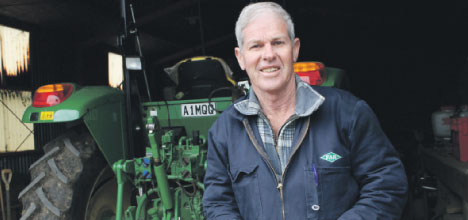
Growing maize on effluent paddocks is good for the farmer's pocket and for the environment, says Mike Parker, Foundation for Arable Research maize project manager.
'Trials we did on eight Waikato farms showed no significant difference between the yield from paddocks, which had starter plus side dressing of fertiliser, and the effluent paddocks which had none at all,” says Mike, who is based in the Waikato.
Mike Parker, Foundation for Arable Research maize project manager.
Soil samples, taken from a depth of up to 900mm, before sowing and during growth of the maize, showed there was good up-take of nitrogen by the plants thanks to soil microbiology making it available from mineralisation of the organic matter.
Maize is effective at removing nitrogen from the soil, reducing the risk of it leaching into waterways, and not having to apply additional fertiliser is a cost saving for farmers, says Mike.
However, farmers need to confirm what is in their soil before making decisions and the best N test is to take samples from 0 to 600mm deep (when the maize has two visible leaf collars) and enter the data into the Amaize –N calculator to give a side dressing recommendation. Unfortunately, soil sampling to 600mm isn't fast work. 'It can take me up to an hour to do 10 samples, but the benefits are a considerable cost saving while also preserving the environment.”
FAR's role is to provide growers with accurate, reliable and independent research. Much of which is funded by a levy of $7.20 per bag of seed and paid by all maize growers, which enables FAR to conduct up to 20 maize projects a year.
The research has included comparing no-till, also called direct drill, with conventional cultivation and Mike says there are pluses and minuses for each.
No-till
'A five year trial at Tamahere [in the Waikato] showed no significant differences in yields but direct drill saves about $200 per ha in cultivation costs. However, soil temperature initially in direct drill paddocks is 1.5 to 2 degrees Celsius cooler than in cultivated paddocks. But direct drill paddocks retain three to four per cent more moisture, which is significant in a drought year.”
With the direct drill method, vegetation is first sprayed out and the soil left undisturbed, other than by the seed drill. In conventional cultivation, vegetation is sprayed and then the soil is turned over. 'This method is especially useful if soil had been badly pugged by animals and it does help increase soil temperature which aids germination. It's horses for courses really, and growers have to decide which situation works best for them.”
Mike says a significant proportion of the maize levy is spent on weed research; and a new FAR focus on weed control in maize for growers is being put together by himself and Diane Mathers, FAR's Hawkes Bay-based maize and farm systems research co-ordinator.
Managing weeds is one of the biggest challenges maize growers face. The unwanted plants can not only cause a reduction in crop yield and quality, but there is also a risk of spreading weeds to uninfected farms when the crop is fed to livestock.
Weeds
'Biosecurity incursions are a big issue for the industry; and at the moment we are working on three eradication/control programmes for weeds affecting the industry.”
Another FAR-led three-year $450,000 project, principally funded by the Sustainable Farming Fund, is looking at avoiding resistance to glyphosate (Round up).
'Resistance to glyphosate has been found in two different rye grass species in vineyards in Marlborough.”
Glyphosate is a very effective, low cost chemical which is widely used particularly for conservation tillage – and Mike says should other plants develop resistance to it that would be of major concern for the industry.
It is the repeated use of the chemical, particularly along roadsides, fence lines, waste areas, and in vineyards and orchards, which can lead to development of resistance.
Using a range of chemicals to control weeds is ideal to avoid resistance. But Mike says that is not always easy, as many overseas markets only allow certain products to be used on products exported from New Zealand.
One weed currently of particular concern is yellow bristle grass, an extremely aggressive annual seeding plant which spreads rapidly through clean pasture and cows don't like to eat it. Yellow bristle grass is difficult to see until it produces a seed head, and by then its seed is probably viable and dropping for next season. Part of the research is aimed at an integrated control strategy, which also includes helping farmers identify the plant early on in the season so that herbicides can be applied before seeding occurs.
To find out more about the work of the Foundation for Arable Research go to: www.far.org.nz

0 comments
Leave a Comment
You must be logged in to make a comment.