


Rain is falling but all the colours of a tropical sunny day are inside the big marque on the Tamakautoga Village green.
Lines of beautiful hand-stitched bed linen sway in the gentle breeze under the awning where the crafts of Niuean women are being judged as part of the village show day.
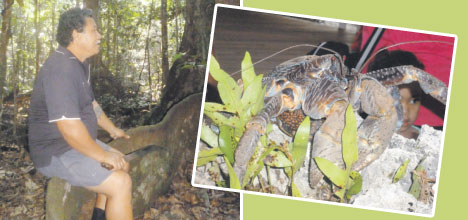
Jack Feleti, master carver of Niue, still hunts uga (or coconut crab) and wild pigs in the rain forest. The uga (or coconut crab) is the largest living land arthropod in the world, weighing up to 4kg.
Each piece is a testament to the needle skills used to stitch, frill and applique designs on covers for single and double beds and pillow cases.
Nearby, there's tables display samples of weaving, jewellery and floral crafts. And a short distance across the village green, another open-sided marque shelters baskets of locally grown produce – taro, onions, kumara, yams and even peanuts and live uga (coconut crabs), laid out for the judges' inspection.
The rain, (more of a gentle drizzle which brought welcome relief from the humidity of the day before), doesn't deter locals and tourists from lining up to buy umu (hangi), cooked food and other tasty treats from palm leaf-decorated stalls on the other side of the green.
This is show day in the village, and later there will be singing and dancing – reminiscent of A&P Shows in New Zealand, except there are no animals to be judged. The village dogs and chickens aren't on the schedule – they have roles, however, as part of the clean-up crew after everyone has left.
The island of Niue, which lies between Tonga and the Cook Islands (a three-and-a-half hour flight from Auckland), has 14 villages, as well as the main centre of Alofi. And each village hosts a show day when handcrafts and produce are judged and funds are raised for village projects.
Most villages are a collection of occupied and abandoned homes, lining the roadside, close to a church of one of the six religions on the island.
Tamakautoga Village is a few minutes' walk from the Matavia Resort where we were staying; and the show day provided a glimpse of village life on the 259 square kilometre island – which takes just one-and-a-half hours to drive around.
Apart from the grassed areas around the neat homes in the villages, Niue is covered in vegetation, with the Huvalu Forest Conservation area, accounting for something like a fifth of the landmass, still in ancient rain forest. Areas adjoining the forest are also protected by the villages and the families on whose land it grows.
Outside the forest, vegetation is burned, bulldozed to crush the rock, and planted as part of a traditional six-year gardening rotation system.
The tiny island's main exports are noni products made from the fruit of the Morinda citrifolia tree, vanilla, taro and honey. Increasingly, now Air New Zealand has weekly flights, tourism is becoming an important earner.
Niue is self-governed in free association with New Zealand, has a Premier with a cabinet of three ministers, and a legislative assembly of 20 members. Its population in 2012 was 1400, well down from the 5200 in 1996. Today, 20,000 Nepean's live in New Zealand, most in Auckland; and another 2000 are in Australia.

0 comments
Leave a Comment
You must be logged in to make a comment.