


Leading by example may be an effective way of improving farming environmental practices believes Beef + Lamb New Zealand Mid-Northern North Island extension manager Erica van Reenen.
That's why she's suggested a mentoring scheme through which farmers becoming 'environmental champions” would help others understand the environmental, management and financial benefits of implementing change.
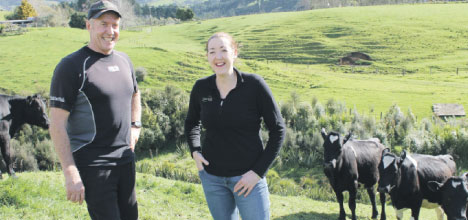
Rick Burke of Katikati and Beef + Lamb's Erica van Reenen both believe a mentoring scheme
may help more farmers adopt environmental practices on farm.
'There are many good farmers out there doing good things. They could facilitate further environmental enhancement by helping their neighbours do the same, and speak up when fellow farmers are not doing the right thing.”
Erica's mentoring proposal is one of several in her comprehensive and well-researched report ‘Increasing uptake of environmental practices on sheep and beef farms', which she undertook as part of a Kellogg Rural Leaders course in 2012.
Erica interviewed 13 sheep and beef farmers in the Waikato, Taumarunui, Bay of Plenty and Taupo regions who are active in implementing environmental management on their farms, to discover what motivated them; and importantly, the challenges they faced in doing so.
Costs
Not unsurprisingly the costs of fencing riparian areas and planting trees and shrubs is a limiting factor, but all the farmers Erica interviewed are still motivated to do so – many because they believe it is important to leave the land in a better state for the next generation.
Rick Burke of Katikati has found there are economic as well as amenity benefits to be gained from fencing out and planting parts of the farm.
'We are now getting better production, increased fertility, better rotational grazing systems and not wasting fertiliser. And [we] don't underestimate the value it adds to a farm in terms of the vista and capital value,” says Rick.
'Every farmer you talk to has problem areas which don't grow grass well, where weeds are an issue or stock get stuck or are hard to move from. Once we fenced off and planted those areas on our farm, the problems pretty much went away.”
Bird life
Rick says protecting and planting streams has reduced flooding and erosion but he acknowledges it takes time to establish; and weed control, in particular, is an issue in the early stages. 'Another benefit is the increase in bird life. We now have tui around the house and a flock of kaka too.” Rick's now keen to become a mentor, believing one-on-one information sharing can be highly effective.
Erica also wants to see a website set up which would draw together the vast amount of information available for farmers into one place. Her idea is the website would summarise the pertinent information and provide links to more for those who want it.
The farmers she interviewed say the industry needs strong leadership from politicians (and not just those in government), and industry leaders who would have the courage to tell farmers what they needed to hear, not what they wanted to hear.
Farmers who have achieved the most on their properties are those who have good relationships with regional council staff. But there remains, among many farmers, a distrust of councils and this needs to change.
But Erica says it goes both ways, regional council staff need to put themselves in farmers' shoes also. Farmers say they felt pressure from the urban public and the media over their farming practices and the 'dirty dairying” label had also hurt dry stock farmers.
However, many farmers also acknowledge the negative publicity is a driver for change.
Greenies
Erica also interviewed well-known and outspoken 'greenies” who showed a certain sympathy and understanding for the farmers' plight, acknowledging that unless farms were profitable, it was hard to spend money on the environment.
However, they also say many farming practices are outdated and continuing to farm on marginal land, high stocking rates, polluting waterways and causing erosion, is not acceptable.
'Our long-term viability depends on looking after the resources our farms are built upon – we know that, but sometimes it seems ‘too hard'. It's not,” says Erica.
'The project provides real life insights into how farmers are successfully incorporating sound environmental practices on farm – and doing so profitably and with great personal satisfaction.
'As an industry we have an opportunity to take a proactive approach to dealing with this challenge. A proactive approach could involve all major stakeholders – including farmers, local and central governments, bankers, vets, sales representatives, environmental groups, recreational water users – getting together to find solutions for individual farming businesses.
'Increasing environmental practices on sheep and beef farms will ultimately come down to sheep and beef farmers understating what is needed, realising the benefits to their businesses, finding the right way to implement change on their farms and helping others achieve the same thing. In other words the solution is all about people.”
To obtain a copy of the report contact Erica van Reenen phone 07 839 0286 or
027 556 8836 or email: [email protected]

0 comments
Leave a Comment
You must be logged in to make a comment.