


Significant chemical use and chemical footprints in the Bay of Plenty primary sector will be scrutinised at a Green Party public meeting tonight.
On at the Welcome Bay Community Centre hall from 7pm - 8.30pm, the ‘Do you get the drift?' community meeting sees Green Party agriculture and organics spokesperson Steffan Browning focusing on the use of the chemicals sprays, Roundup, Hi-Cane and methyl bromide fumigation.
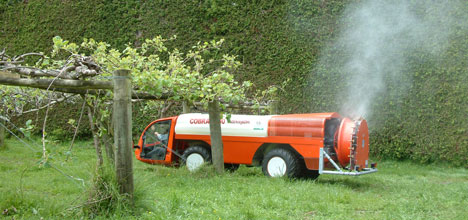
Hi-Cane spraying is one of three topics set down for tonight's ‘Do you get the drift?' Green Party public meeting.
'The Bay of Plenty is an important export hub of primary production with forestry, kiwifruit and dairy making up the majority of exports.
'All three of these sectors have a significant unsustainable and unnecessary chemical footprint that needs to be addressed to ensure our reputation as a clean green producer stays on track,” says Steffan.
Karen Summerhays, former Bay of Plenty Regional councillor from 2001-04 and 2007-10, is also speaking on the Scion versus regional council Environment Court case regarding genetically modified organisms.
During the hour and a half meeting, the audience will also be given the chance to explain their stance on the chemicals and their use in the region. .
'Chemicals such as log fumigant methyl bromide, the kiwifruit spray Hi-cane and the widely used Roundup are too often used and are dangerous to human health and the wider environment. There are alternatives to our community and environment being exposed to them,” says Steffan.
Of the trio, Steffan admits Hi-Cane and methyl bromide are of serious concern to the Bay – Hi-Cane through the recently finished Kiwifruit spraying season and the later used the Port of Tauranga.
The annual spraying season, running from mid-July to late August, sees orchardists spray fertilisers and Hydrogen Cyanamide, known as Hi-Cane, on their kiwifruit vines encouraging bud-burst and achieve consistent size and yield of fruit.
Orchardists must notify neighbours, place signage along the road verge and only spray in suitable wind conditions while council is responsible for ensuring all agrichemicals are used correctly and in an environmentally safe manner through their Regional Air Plan rules.
According to the Clean Area Act, orchardists are required to notify neighbours at least 24-hours prior to spraying.
'This would be the single biggest place in New Zealand where it is used; it's the biggest port in terms of logs. Methyl bromide is released in Tauranga; they can't see where it's going, they can't smell it and they can't taste it. It's a very serious toxin connected with motor neuron disease.
'Rather than seeing it as a cost it's something we [being chemical free] can stand tall about when we market our produce and market our produce. We need to see it as an opportunity rather than a cost.”
When: 7.00pm – 8:30pm
Where: Welcome Bay, Community Centre Hall, 244 Welcome Bay Road, Tauranga

2 comments
People of Tauranga
Posted on 24-09-2013 12:35 | By Sam Bailey
You should have been at this meeting! Thanks for the presentation Steffan and Karen. It was eye opening and disturbing. I would like to know what monitoring systems are in place at the port for methyl bromide.
Overit
Posted on 24-09-2013 16:42 | By overit
I live in Welcome Bay and my concern is what Citycare are doing in Johnson Reserve. It appears toitoi and raupo are being sprayed out of existance. This is a wetland!! What is their desire to open it up? Creatures live in this environment, ducks have nests there, whitebait come up the stream to lay eggs. They spray the edges of the track and have killed off young trees they have planted. (It beats me this need to manicure all the shrubs about the parks with hedge clippers too). These sprays end up in the water system eventually - leave it a wild wetland. Humans have enough access to its beauty now. I think there is some fobia by Citycare that human predators live in wooded areas. Coronation park is testament to that.
Leave a Comment
You must be logged in to make a comment.