


Phosphorus is essential for food production, however the world's easily mineable phosphorus resources are limited, warns Dr Gina Lucci of AgResearch.
'We don't have an infinite phosphorus supply and the state of the resource has been compared to ‘peak oil'.”
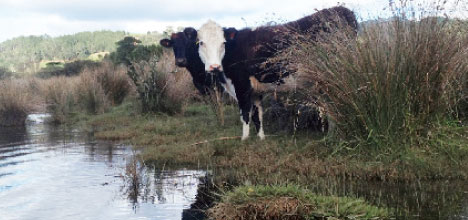
A planted riparian/buffer area, reduces the leaching of
phosphorus and sediment.
Predictions are that phosphorus production will peak at about 30 million tonnes by 2030, and then begin to decline to less than 10 million tonnes by 2100. However, population growth, influencing demand for food, will increase from the current 6.8 billion to 11 billion by 2050.
That's one of the reasons it makes sense for farmers to be judicious with applying phosphorus fertilisers, and reduce losses of phosphorus from their land, says Gina. Phosphorus is essential for life and phosphorus loss, along with nitrogen, into waterways is a contributor to the eutrophication of surface waters, which can in turn lead to the degradation of aquatic habitats and overall water quality. Phosphorus loss is closely related to soil loss and water quality issues, unlike nitrogen and sulphur which do not bond to soil.
A number of factors influence phosphorus leaching, including soil types, topography, and the type of fertiliser applied. To help reduce nutrient loss, farmers can create and foster a strong growing sward of grass to blot up nutrients. Reducing erosion and creating riparian strips (where possible), so deep rooted plants like flaxes and tree crops can absorb nutrients, are other options. Detention dams and silt traps created above culverts, and in conjunction with plantings for erosion prevention, also helps.Using RPR slow release phosphate fertiliser and elemental sulphur, instead of super phosphate, is recommended as acidic soils will allow slower acidulation and release of phosphorus and sulphur for root uptake.
'Nutrient loss is an economic loss for the farm system, and excess nutrients and soil particles are polluters of waterways, as they reduce water quality. Clean water is an essential for life and economic, municipal and human activity downstream from farms,” says Gina. Farmers can use the online S-Map fact sheet, produced by Landcare Research (www.landcareresearch.co.nz/), to determine their soil type and its phosphorus retention capacity.
The average soil P retention for each soil is included in the Soil Series Fact Sheets, also available from Landcare Research (http://smap.landcareresearch.co.nz).
'Eighty-per cent of all phosphorus losses occur from 20 per cent of the farm area. Therefore, mitigation strategies should be prioritised in those 20 per cent of the farm which are sources of phosphorus,” says Gina. 'Soil is like a sponge, but at times it can't absorb all the rain, which runs off the surface taking soil and nutrients with it. In general, May through to October are the riskiest months, so it is best to avoid applying phosphorus fertiliser during that time.” Grazing is a critical factor in reducing phosphorus leaching, and management practices include restricted grazing in some areas during rainfall events, lower stocking rates and excluding stock from vulnerable wet areas, Gina says.
Robert Carter, who farms 333ha at Kirikau in the King Country, believes in reducing nutrient leaching and keeping soils on the hills to grow pasture.
'Soil is our growing medium and is best left on the hills so we can grow grass.” Riparian strips around waterways, planted with deep rooted species including flaxes, is one method Robert has used.
'We have left some scrub [mainly manuka] growing on hillsides where it is not economically viable to take it out, and control the grazing under it.
'We have put a silt trap above of each culvert and scoop it out with a muck spreader and take it back to the top of the hill to grow grass again.” Robert applies a good quality RPR slow release phosphate fertiliser and uses Overseer nutrient budgets to determine what the soil needs and where. 'We try not to apply fertiliser around waterways where possible.”
For Robert, looking after the land and reducing nutrient leaching is about more than enhancing his farm business. Protecting the environment for future generations and for wildlife is important, and so is protecting water quality.
'Clean water is essential for life.”
# Dr Gina Lucci and farmer Robert Carter were among the speakers at the Beef + Lamb New Zealand Farmer Road Shows.

0 comments
Leave a Comment
You must be logged in to make a comment.