


'Planting the wrong plants around waterways and wetlands can sometimes be worse than not planting any at all,” says Louise Clark, a senior ecologist with
Boffa Miskell.
However, knowing what to plant isn't easy which is why Louise developed a ‘wheel' to help farmers make the right choices. 'It was one of those inspiration-in-the-shower moments,” she says.
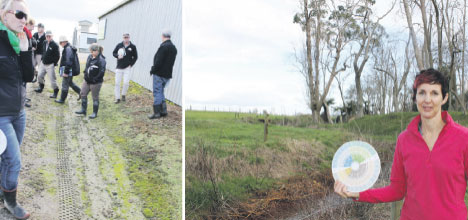
Left: Establishing a grass filter strip alongside a farm race and building, such as this, is a low cost way to improve water quality.
Right: Louise Clark, a senior ecologist with Boffa Miskell with the wheel, called the ‘Plant Selection Tool for Waikato Waterways', which she developed.
However, researching, designing and testing the ‘Plant Selection Tool for Waikato Waterways' was to prove challenging – and only became a reality thanks to funding from the Waikato River Authority. The result is a dinner-plate size cardboard wheel, divided into sections, to guide users through the process of selecting plants best suited to the objectives to be achieved – and the soil and climatic conditions of the land near their streams and drains.
Louise explained the background to the wheel's evolution, and its use, in a series of workshops for farmers and consultants co-funded by WRA and DairyNZ which hosted the workshops. Those who attended the workshops also visited DairyNZ's Scott Farm at Newstead for practical guidance on using the wheel.
Dart board
The wheel, laid out a bit like a dart board, is read from the centre outwards in concentric rings. The middle ring lists four issues that can be addressed by riparian plantings – bank stability, contaminants, fish habitat and biodiversity. The next ring lists specific objectives to be achieved, followed by a choice of wet, normal or dry soil types in the next ring. The outer two rings contain numbers which relate to plants listed in tables on the reverse side of the wheel, those which are frost sensitive, and those which are frost tolerant. In all, 77 plants are listed with both their Latin and common names.
Louise says, in compiling the list of plants, she reviewed 60 reference sources from early Forest Service publications to the latest NIWA research, seeking out plants which would perform in Waikato riparian environments. 'The plants on the wheel are those that are specifically found in the Waikato and Waipa River catchments, and all their drain and stream tributaries; so it's important that the wheel isn't used in other river catchments.”
From an original list of 158 New Zealand riparian plants, 117 are found in the Waikato. Of these, 82 are available in nurseries. 'I then took out any which were toxic to stock or don't survive well in plantings and was left with 77.”
Simple
Her work was peer reviewed – and in a final test – Louise gave a wheel to her father, Kingsley Saunders, a retired farmer. 'Dad figured it out pretty quickly which gave me confidence other farmers would also find it easy to use. I had aimed for a `simple is best' format.”
Louise suggests landowners take the wheel and the accompanying pamphlet out to their waterways and use their observation skills and knowledge to decide the best objective for their riparian plantings. 'In some cases, there may be more than one objective and many plants will help achieve more than one anyway. Farmers know their waterways and land better than anyone else. They will know which areas are prone to flooding, which waterways have fish in them, and where erosion is happening.”
It was her own experience growing up on a farm near the Waihou River which Louise credits for giving her an interest in riparian margins and their functions. 'As a child, we used to get big trout and eels out of the Waihou River. Then the trees were removed, as part of a flood control scheme, and we lost the fish life. The amount of erosion along the river was huge, and the water was filled with sediment. The impact of that tree removal has stayed with me.”
However, the plants listed on the wheel aren't all trees. Cutty grasses, toetoe, silver fern, sedges, rushes, New Zealand blueberry, and of course, flaxes are listed too. Louise is also an advocate for using grass filter strips which are included on the wheel. She says they are especially beneficial alongside farm drains as a low cost but very effective way to help improve water quality.
If you would like a wheel and pamphlet, they are available free of charge from DairyNZ, WRA, and Waikato Regional Council.

0 comments
Leave a Comment
You must be logged in to make a comment.