


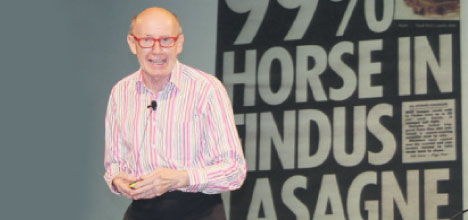
When professor David Hughes walks into his local supermarket, the store greets him (on his mobile phone) and will more than likely make him a special and exclusive offer on a product it knows he likes.
It's not that David is a celebrity (even though he is emeritus professor of Food Marketing at Imperial College London). It's that he's a great customer and the supermarket has the technology to recognise and reward his loyalty – and David doesn't mind.
The British media had a field day with the ‘horsegate' scandal, says professor David Hughes.
'It's not scary nor intrusive. I like it,” he says. Tesco uses the information gained every time David swipes his loyalty card to gather data on his preferences. Now it has taken that even further with the offer of free Tesco Telly, which screens BBC programmes with advertising targeted at David.
Supermarkets have been forced to become smarter and use technology to their advantage because of the impacts
of the global recession and a reduction in consumer spending by a population in which it has 'become fashionable to be a ‘SuperScrimper' who wastes not wants not”.
'Online shopping is going like a train. Ten years ago it was eight per cent. By 2020 it will be more like 20 per cent,” says David. Shoppers make their purchases any time of the day or night online and chose to have the groceries delivered; or they can drive by the supermarket and pick them up when it suits.
'The ‘Big Night In' is a successful department at ASDA store which puts together a package of products.
How fruit and vegetables are consumed is also changing. 'You are more likely to drink a pear than eat one.” Combinations of juices, which provide almost all of the recommended daily requirements for nutrients, are popular for children's lunches and among women.
Not everyone wants to eat meat and vegetables, and producers are now targeting ‘Flexitarians” who like ‘veg and 3 veg' for lunch with a gluten-free, cholesterol-free, vegan product called ‘Chicken-free strips' – plant-based protein made from soyabeans and peas. Apparently, says David, they are ‘quite tasty'.
The smart way to increase consumption of fresh produce is to team up with the producers, of sauces and spreads, who want to benefit from the good image fruit and vegetables have. 'These companies want the halo effect of fresh products.” An example is the marketing by a spread called Luripu which suggests spreading its product on broccoli.
Supermarket chains are also opening small convenience stores in neighbourhoods. 'Some people are weighing up the cost of time and money travelling to a large supermarket against paying slightly more from a convenience store.” By shopping more frequently they can also limit their spending to the money they have available on that day.
Type 2 diabetes is costing the UK taxpayer $140 billion a year and the Government is now putting pressure on consumers to eat more healthy food because it can't afford the spiralling health costs.
David says the economic centre of gravity is shifting away from Europe to Asia, which is to the advantage of New Zealand producers. 'More people with more income is good news for fresh produce. Should growers lie back and relax? No, buckle up your seat belts and put your crash hats on – it's never a straight line to the north.
'Regional and bi-lateral trade agreements will bring terrific opportunities, but also strong competition. In future, fewer, larger, more sophisticated businesses will survive and prosper.”
# Professor David Hughes, Emeritus Professor of Food Marketing at Imperial College London, was the keynote speaker at the Horticulture New Zealand Conference in late July.

0 comments
Leave a Comment
You must be logged in to make a comment.