


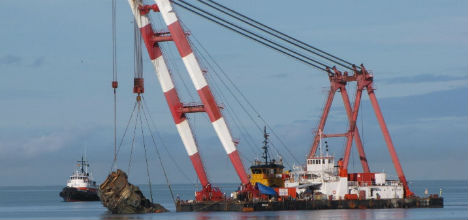
The first of two heavy lift floating cranes to remove the accommodation block from the submerged Rena wreck is expected to arrive later this month.
With good weather, the ship's ‘house' - the four storey accommodation section on the sunken stern - should be in port and being dismantled during December, says Rena projects spokesman Hugo Shanahan.
The smaller of the two crane barges is expected next month.
The four storey accommodation block is located in the stern section of the cargo ship in 30-50metres of water. Cutting on the block was earlier expected to start in October, almost two years since the ship ran aground.
The 236metre ship carrying 1368 containers and 1733 tonnes of heavy fuel oil hit the Astrolabe Reef about 25km from Mount Maunganui travelling at 21knots on October 5, 2011. The ship eventually split in half with the stern section sinking below the waterline.
The operation to remove the accommodation section will involve chain-cutting and removing the block in two sections. The actual removal is expected to only take a few days, but a lengthy preparation period is required.
The operation requires two new, large crane barges. The RMG 500 crane barge is due to arrive at the end of September, followed by the RMG 1000 and an anchor-handling tug in mid-October.
The plan is to saw off the accommodation block in two sections by using a chain pulled back and forward from a moored barge. The actual cutting is an operation that will take a weather window of only a few days. But the whole operation, mooring the heavy lift barges and preparing the cut, is expected to take 80 days in total.
The Rena owners and insurers say they made the decision to remove the accommodation block from the submerged section lying down the slope of the reef because it is built of lighter gauge materials than the ship's hull and will eventually break up.
'Our environmental experts have not identified any environmentally harmful material in the accommodation block,” says Captain John Owen of the Swedish Club.
'Any debris that might be released and eventually wash ashore would be picked up by the shoreline monitoring and clean-up process we have put in place.
'We understand people do not want the uncertainty of not knowing when this might happen and how long it could go on for. Although there is a considerable cost to removing the accommodation section, we recognise the importance of minimising the effects on the community of the Rena grounding as much as we can.
'We appreciate the accommodation section would have been of interest to recreational divers, and our initial approach was to consider leaving it as part of the wreck after making it safer for divers,” says John.
'We could not tell how long it would stay in that condition before the effects of wave action and the strong currents caused it to deteriorate and become a hazard to their safety.”
Resolve Salvage & Fire will remove the accommodation block in two sections. Once each section is cut away, it will be lifted onto a third barge for transport to Port of Tauranga where it will be dismantled for scrap and recycling.
Meanwhile, debris removal cleaning-up the reef between the bow and sunken stern sections continues. So far 743 tonnes of material has been removed and shipped to shore.
Divers have identified and removed the first of two remaining containers holding plastic beads in cargo hold four. They are awaiting settled weather to investigate the remaining contents on the second container and remove as far as practicable.
Findings from dive surveys of holds five and six are being compiled and will be reported through once complete. The survey's main purpose is to locate and assess the remaining state of the four containers of interest: three holding ferrosilicon in hold five, and one containing copper in hold six.
Once the photographic record is complete, salvors will determine whether the four remaining containers of interest and/or their contents are still within the wreck, their condition and the appropriate way of dealing with them.
Resolve Salvage and Fire is close to clocking up 400 days in New Zealand of which for more than 200 days they have been unable to work on-site due to weather conditions.
The reduction of the bow to at least one metre below the lowest astronomical tide was completed last month.

0 comments
Leave a Comment
You must be logged in to make a comment.