


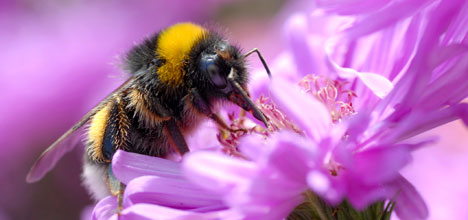
Bumble-bees might be part of the solution to the avocado industry's ‘boom and bust' cycle of trees producing one year and not the next, says AVOCO technical manager Colin Partridge.
Bumble-bees could help the avacado industry.
'If avocado growers could soon be able to call in special reinforcements to pollinate their trees – the not-so-humble bumblebee – it will do a lot to stabilise the industry and could even help overcome the persistent boom/bust nature of the harvests.”
Avocado growers will hear the latest research findings on the use of bumblebees as pollinators, at the Australia-New Zealand avocado conference in Tauranga next month, and AVOCO, as principal sponsor of the conference and the largest grower group, appreciates the significance of the research, says Colin.
Dr David Pattemore, a pollination scientist at the New Zealand Institute for Plant & Food Research, is bringing his findings to the September 9 to 12 conference. David's research is funded with assistance from Pollen Plus and the Avocado Industry Council.
'We know for many crops that bumblebees are much more effective as pollinators [than honey bees]. They carry more pollen and are better at cross pollination.
'Each bumblebee does the work of 50 honey bees on kiwifruit, and we are expecting the ratio to be pretty similar on avocados.
'The overall aim of our research on avocado pollination is to find ways to increase fruit set in years that would typically result in low fruit numbers. We believe that providing growers with the ability to manage highly effective bumblebees is an important part of the solution.”
The researchers started by building artificial nesting boxes to attract bumblebees. A pilot trial was run in five Bay of Plenty avocado orchards which were monitored to determine the percentage of hives occupied and the size of the colonies achieved, and this information will direct future research.
'Our biggest colony in our nest boxes last year was 1500 bumblebees, and overall we had a success rate of 33 per cent. That's right up there with the best studies worldwide.”
David says bumblebees are social bees like honey bees. 'As yet, we don't have the same methods for managing them. It is worth investigating, however, as growers could eventually be able to reduce their reliance on honey bees – and get away from relying on a single species.”
With varroa mite and other factors affecting honey bee hive health, it is becoming expensive to bring in honey bee hives for orchard pollination, says David. 'Current prices are at the limit of what avocado orchardists can afford. We expect that these prices will rise further in the years ahead.”
Colin says bumblebees are hard workers and are seen to forage in much cooler and darker conditions that honey bees will. 'I hope this research will be leading to good results that our growers can implement to increase fruit set."
The avocado industry is plagued by the ‘boom and bust' nature of the harvest, with trees tending to produce copious amounts of fruit one year, then little the next. This is known in the industry as irregular bearing. Part of the problem is the trees have maturing fruit and next season's flowers on the tree at the same time.
Dr David Pattemore is one of the guest speakers at the three-day conference. The bumblebee research is just part of his speech, and field trips will demonstrate the nest boxes. Further details about the conference are available at: www.avocadoconference.co.nz

0 comments
Leave a Comment
You must be logged in to make a comment.