


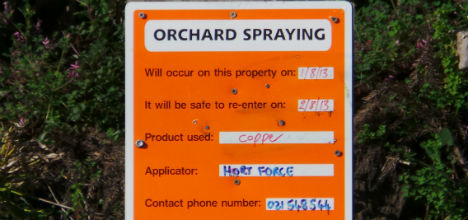
With the start of the kiwifruit spraying season already resulting in three complaints, the Bay of Plenty Regional Council is encouraging people to take care and be smart around spraying areas.
From mid-July to late August orchardists spray Hydrogen Cyanamide, known as Hi-Cane, on kiwifruit vines to encourage bud-burst and achieve consistent size and yield of fruit.
Spraying is happening down Tangitu Road in Te Puna.
Council's pollution prevention manager Nick Zaman says council received the three 'relatively minor” complaints in the first two weeks of the season that have now been addressed.
The complaints include a non-notification, claims it was too windy for spraying to occur and questions regarding sensitive areas in the region. The last complainant has been invited to the Bay of Plenty Spray Focus Group, says Nick.
Since 2009, the focus group of representatives from Zespri, NZ Kiwifruit Growers Inc, Kiwifruit Vine Health, the public and regional council staff have worked to reduce spray drifts and its effects on the community.
Senior regional council pollution prevention officer John Morris says last spray season the Council received 11 complaints about Hi-Cane.
'This was a great result and we really hope that everyone plays their part again this season to reduce this figure even more,” says John, who is also chair of the focus group.
'I believe this was a direct reflection on the efforts that everyone put in over the years since establishing the Spray Focus Group. But we can't get complacent on one good result. All the good work over the past few years can be undone so we need to continue to strive for improvements.”
Under the Bay of Plenty Region Air Plan Rule 13, when spraying agrichemicals, excluding non-motorised hand held and aerial application, neighbours of any adjoining property within 50m of agrichemical use must be notified.
If an agreed form of notification has not been reached notification must be no earlier than 20 days and no later than 12 hours before the agrichemical use.
Where agrichemicals are applied to land adjoining public roads and places, signs must be placed on the road boundary 24 hours before the time of application.
'The Council can make a formal written warning, abatement notice, instant fine or in serious cases a prosecution if people did not abide by the rules,” says John.
Council is responsible for ensuring all agrichemicals are used correctly and in an environmentally safe manner through their Regional Air Plan rules.
The NZKGI best practice guidelines also encourage any community members to report operators who fail to conform to industry best practice.
The guidelines promote prominently displayed signs letting people know spraying is being carried out. When spraying, orchardists must cover their mailbox with a yellow plastic bag supplied by NZKGI indicating to people spraying is happening on, or near, the property.
Honorary wardens provided by NZKGI have been trained to investigate complaints immediately, and rural post delivery people are also being trained to recognise and report any problems as mobile ‘eyes and ears'.
If anyone is concerned about a neighbour spraying they should contact the council's pollution hotline on 0800 884 883.

1 comment
is it true
Posted on 06-08-2013 13:15 | By ratepayer
the clean air act was repealed in 1991 when the resource management act came into force. the BOP regional plan states, rule 13d schedule 2, notification to adjoining property with in 50 metres of application 12 hour notification ,24 hour if spraying next to a public place--true or false
Leave a Comment
You must be logged in to make a comment.