


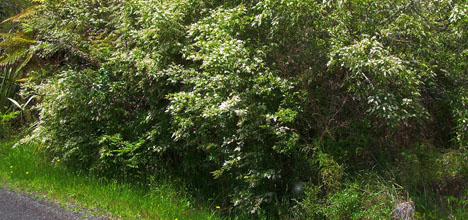
A plant that everyone loves to hate is currently in flower throughout the Bay of Plenty region.
Chinese privet, which blooms throughout the Bay of Plenty from September to December, is one of two common privet species found in the region. Another species, tree privet, flowers from January to March.
Privet.
Environment Bay of Plenty Pest Plant Officer Des Pooley says the regional council receives complaints each year about the plant.
'While we can't enforce removal of privet, we do encourage it,” says Des.
'If it's your neighbour who has the offending trees on their property, I suggest a polite request to them and an offer of assistance in their removal might be the best solution.”
The unpopular tree is best killed by poisoning the stumps after the trees are cut down.
'Without poisoning them, the plants are likely to grow back into more problematic, multi-headed monsters,” says Des.
After cutting, spray the stumps with a 1:5 mix of glyphosate (Round-up) in water. This must be done within 15-30 minutes of cutting. Seedlings can be sprayed with 150ml glyphosate in water.
Chinese privet is a small evergreen tree with small dull green leaves. Its small white flowers are strongly scented.
The Auckland Allergy Centre believes privet is being blamed for allergic reactions that are in fact caused by perennial ryegrass.
Privet produces a highly scented flower, which is an irritant to most allergy sufferers, but the centre says it is not a strong allergen. Skin prick tests in hay fever patients rarely give a positive reaction to privet.
Most people who think they are allergic to privet are actually allergic to ryegrass, which is not as visible as privet.
Perennial ryegrass is the biggest pollen producer of all, and the major cause of springtime hay fever in New Zealand.
The pollen season varies, starting about one month earlier at the top of the North Island than the bottom of the south Island. In Auckland the main pollen season is between October and February, but because the seasons are so variable the pollen season is not well defined.

0 comments
Leave a Comment
You must be logged in to make a comment.