


Duck shooters took home about 4300 fewer birds on opening weekend this year, a reduced bag that justifies the shortened season, says Eastern Region Fish and Game Manager Rob Pitkethly.
An estimated 11,500 mallard and grey ducks were shot in the Eastern Region on opening day this duck shooting season, a drop from last year's estimated opening weekend kill of 15,800.
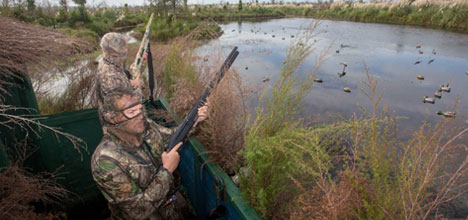
Hunters try their luck in the Kaituna wetlands on opening morning. Photo: Jamie Troughton/Dscribe Journalism
Fish and Game says while this is a drop from last year, it is better than the estimated 9500 birds taken in 2003.
'Our summer monitoring showed us that the population of mallard and grey duck was low and that was the basis of the Fish and Game Council's decision to limit it to a four-week season,” says Rob.
'Opening day results from the hunter survey show hunters had a low harvest and this certainly supports the reduced season length.”
The Eastern Region stretches from Waihi Beach to Wairoa and includes the Bay of Plenty coastal reserves, parts of the Waikato River and Reporoa, forest including Rotoehu and the Gisborne-East Coast district.
The game bird season for mallard and grey duck finishes at Queen's Birthday weekend in the Eastern Fish and Game Region, although upland game birds and other species such as paradise shelduck and black swan have a longer season extending into July and August.
Eastern Region Fish and Game issued nearly 3400 licenses for the season so far, 200 down on last year, although the game bird hunter survey found only 53 per cent of license holders actually went out on opening weekend compared to the normal average of 73 per cent.
'We suspect this had a lot to do with the drought and hunters heading for their normal ponds were put off by the lack of water,” says Eastern Region Senior Fish and Game officer Matthew McDougall.
The flip side was the birds became more concentrated through the Eastern Region, heading for estuaries, rivers and lakes which weren't affected by the drought, says Matthew.
He says hunters who ventured into these areas generally did well, while the average number of greys and mallards shot was 6.3 birds per hunter, dipping slightly from the 6.5 last year but still well on a par with the last six years.
Matthew says while mallard and grey duck populations are lower this hunting season, paradise shelduck numbers appear good with many hunters collecting their limit, especially in the Eastern Bay and East Cape areas.
'A mallard banded at the Kaituna Wildlife Management reserve in February, 2004 has been shot near Culverden in the Canterbury foothills.”
He says this it is rare to find a banded bird so far from home.
'Around 85 per cent of our banded birds are found within 50km of where they were released, which tells us that people can have an impact locally if they undertake habitat work.
'It's still really interesting to find these birds ranging much further afield, however, and it helps paint a picture of what ducks are capable of.”
The 10-year-old bird was 630km from where it was banded, putting it in the top-10 of distances between Eastern's banding and recovery sites.
The record is a duck recovered in the Waiwera River in South Otago in 2008, a year after it was banded in the Ohuia Lagoon near Wairoa, 1027km north.
Fish and Game have received details of nearly 100 banded birds retrieved already this year – hunters who send in details also go into a draw to win one of 10 free game bird licenses for the 2014 season.
Eastern Fish and Game staff also had a transmitter returned this week, one of 46 fitted to birds in the 2011 season as part of an earlier tracking study.
It was picked up near Otamarakau on the Bay of Plenty coast between Pukehina and Matata.

0 comments
Leave a Comment
You must be logged in to make a comment.