


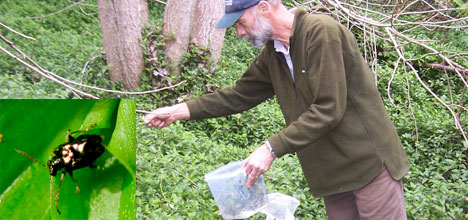
Beetles are being released as biological control agents at new trial sites in the Bay of Plenty.
The Tradescantia Tip Beetle release is the first of its kind for the Bay of Plenty region and was released in the Kauri Point area.
The Tradescantia Tip Beetle was released at selected sites in the Bay of Plenty last week.
The Green Thistle Beetle had already been introduced to specific sites in the Bay and was this week brought to two new sites, both in the Western Bay area.
The Tradescantia Tip beetle is being released in the hopes it will help control the pest plant Wandering Jew, while the Green Thistle beetle may help to control Californian Thistle.
Bay of Plenty Regional control land management manager Robyn Skelton says successful biocontrol agents can help to control pest plants by feeding on them, which can often cause the plant to stop spreading, producing viable seeds, or to die completely.
She says the use of successful biological control agents can offer a cost effective and environmentally sustainable way to help control pest plants in the Bay.
'Establishing biological control agents in areas where pest plants are rife can work well for both the landowner and the environment.
'We've had success with different agents in the past and we are hoping these beetles will establish themselves and help us in our efforts to control these pest plants in the future.”
The beetles are being trialled in specific sites that have been selected because they offer good climate matches for their preferred environment.
They will be monitored for a period of time before Regional Council considers introducing them to other areas in the region.
Regional Council land management officers are working closely with landowners to develop sustainable land management practices on their land, which sometimes include the use of biocontrol agents.
'We've had really positive feedback from landowners on the use of these biological control agents,” says Regional Council land management officer Andrew Blayney.
'Some of the plants they tackle are aggressive and extensive and can significantly affect our environment, economy, and our people. If these beetles establish themselves as we are hoping, then we will look at introducing them to other properties further down the track.”
Te Puke farmer Carol Burt attended a Regional Council sustainable farming workshop on climate change last year.
She is concerned about the effect of climate change on pastoral weeds and was after more information about developing sustainable practices on her land.
After the workshop Carol and Regional Council staff began working on strategies to help protect her land against the predicted impacts of climate change.
A key element of this strategy is the trial release of the Green Thistle Beetle, which took place last week on her family farm.
Carol assisted Council staff in the physical release of the beetle on to her property and says she is optimistic about the agent establishing.
'We've had releases of other types of agents on our property before and had good success with them. In particular we had some beetles that were successful in slowing down the spread and reducing the density of the pest plants Nodding Thistle and Scotch Thistle.
'I'm hoping this beetle will also establish itself and contribute to the eradication of Californian Thistle on our property, which continues to present a problem for landowners.”
The Environmental Risk Management Authority (ERMA) has approved the release of the Tradescantia Tip Beetle and the Green Thistle Beetle as biological control agents in New Zealand after rigorous testing.
Research undertaken by Land Care Research found the beetles to be highly host specific and therefor unlikely to attack other plants.

0 comments
Leave a Comment
You must be logged in to make a comment.