


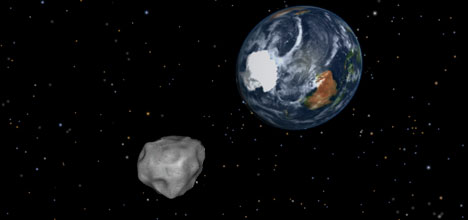
An asteroid as large as a passenger liner and massing an estimated 130,000 tonnes will fly past earth next Saturday.
At its closest at 8.26am on Feb 16, the asteroid 2012 DA14 will fly within 27,680 kilometers of Earth. This is closer than the geosynchronous orbit communications satellites that are 35,800 km above the equator.
The asteroid will fly within 27,680km of Earth. Photo: NASA.
Asteroid 2012DA was discovered on February 23, 2012, by the Spanish La Sagra Sky Survey. Details are sketchy, says the European Space Agency.
From its brightness, scientists estimate the diameter to be between 50m and 80m. Its composition is unknown and its mass is thought to be about 130,000 tonnes.
Asteroid 2012DA14 is approaching from the south and passes at a sharp angle through the path of the satellites. It is not expected to hit any of them.
The asteroid's current orbit is similar to the Earth's, but tilted. The asteroid passes Earth twice per orbit, but February's pass is the closest approach for many decades. As it whips by at a relative velocity of 7.82 kilometers per second, Earth's gravity will slingshot the asteroid into a slightly different orbit.
Detlef Koschny, responsible for near-Earth objects at European Space Agency's Space Situational Awareness office, says the orbit of the asteroid can be computed "quite accurately".
"These computations show that a collision with Earth can be excluded quite safely at least for this century," says Detlef.
"If this object were made of iron and it were to hit our planet, it could create a crater comparable to the 1.5km Meteor Crater near Flagstaff, Arizona, for example. However, it won't.”
Asteroids are a class of small solar system bodies usually rocky or metallic, in orbit around the Sun.
There are millions of asteroids. A large majority of known asteroids orbit in the asteroid belt between the orbits of Mars and Jupiter or like the Jupiter Trojans, co-orbital with Jupiter.
Other orbital families exist with significant populations, including the near-Earth asteroids. Individual asteroids are classified by their characteristic spectra, with the majority falling into three main groups: C-type, S-type, and M-type. These were named after and are generally identified with carbon-rich, stony, and metallic compositions, respectively.


2 comments
ARRIVED LATE??
Posted on 08-02-2013 19:34 | By Crash test dummies
Thought was 21 12 12 was the day so that is two months late or so??
change of orbit
Posted on 09-02-2013 10:33 | By MISS ADVENTURE
So after the flyby the orbit will change, so will it be flung out into space or on to a "closer" path for the future?
Leave a Comment
You must be logged in to make a comment.