


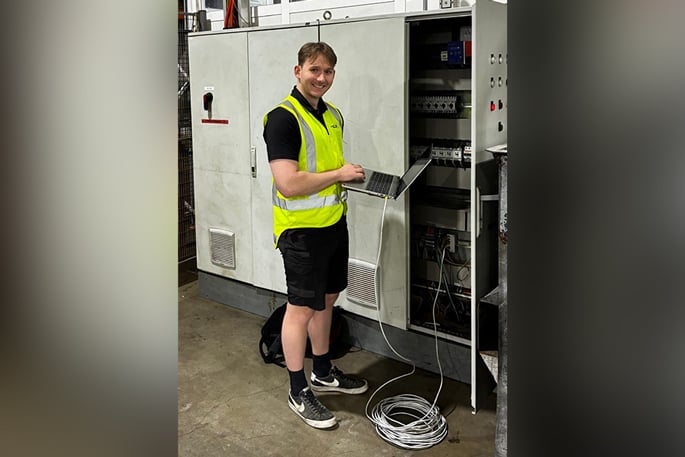
A Bay of Plenty packhouse holiday job opened the door to a high-tech career for 22-year-old automation engineer Ben Tortoiseshell, highlighting growing demand for skilled workers as New Zealand’s horticulture industry heads towards a record $9.5 billion in exports.
Tortoiseshell, now working for agrorobotics company MAF NZ, said he likely would never have discovered post-harvest automation without spending time in a Bay of Plenty packhouse through his brother, an orchard manager.
“There I saw one of the first robotic tray packers at work,” he said in a statement.
Today, the University of Canterbury mechatronics graduate helps programme and commission sophisticated machinery that grades, sorts and packs fruit destined for export markets around the world.
Less than a year after graduating, Tortoiseshell has already completed his first major project independently, commissioning a peach grader in Central Otago after reviewing electrical drawings, writing control and safety programmes, and setting up the operating systems used by staff.
His journey began much earlier.
As a child, he dismantled his grandmother’s washing machine before putting it back together. He also built the watch he now wears.
Despite his interest in engineering, Tortoiseshell said awareness of careers in horticultural automation was low among university students.
“If you walked around a university campus and talked about the big post-harvest automation companies, not a single student would likely know what they do.”
Fellow automation engineer Ben McNabb, 24, followed a similar path.
Raised in Wānaka, McNabb spent summer holidays working in a cherry packhouse near Cromwell before studying mechatronics engineering at Canterbury University.
When an automation role became available at MAF NZ, it combined his industry experience with the work he wanted to pursue long term.
Both engineers’ experiences come as New Zealand’s horticulture sector undergoes rapid technological change.
Robots, machine-vision cameras, artificial intelligence and increasingly sophisticated software are taking on tasks once performed manually in packhouses. However, the technology still requires engineers to design, install, maintain and improve the systems.
Tortoiseshell believes greater exposure to the sector is needed, especially as engineering students face increasing competition for internships and work experience opportunities.
His degree required 800 hours of practical industry experience, but some students struggled to complete that requirement because placements were difficult to find.
Both engineers say paid internships, summer jobs and graduate programmes are critical for attracting more young people into the industry.
McNabb describes summer students as “quite effective advertising” when they return to university and share their experiences with classmates.
For Bay of Plenty, where kiwifruit remains a major economic driver, those opportunities could prove increasingly important as horticulture becomes more reliant on advanced technology and automation.
Chris Bray, business development manager at MAF NZ, said technology was transforming post-harvest operations.
“AI, tech, and data are changing the post-harvest space, which is a platform for New Zealand.”
For Tortoiseshell, whose career began with a glimpse of a robotic tray packer in a Bay of Plenty packhouse, ensuring more young engineers discover those opportunities is now the challenge.
“The machines are already here,” he said. “Getting the right people to run them shouldn’t be left to chance.”

0 comments
Leave a Comment
You must be logged in to make a comment.