


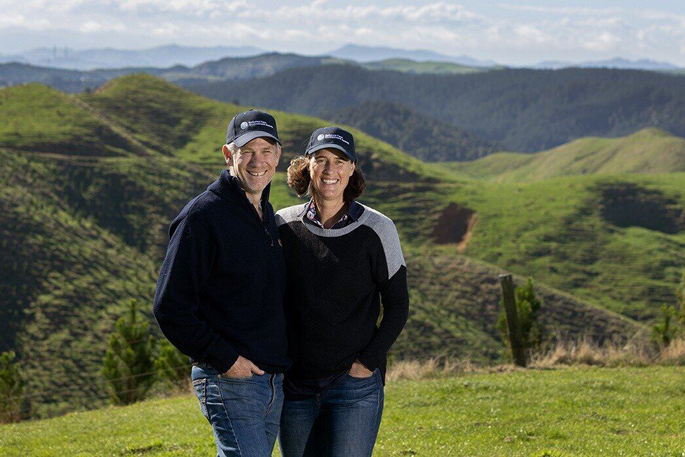
Being part of a grazing research project has shown the owners of a traditional hill country sheep and beef farm that they can improve their property’s profitability and environmental health simultaneously.
New Zealand’s Bioeconomy Science Institute has run hill country grazing research since 2024.
Lead scientists Lisa Box and Tracy Dale started the project under the Ag Research banner before it was amalgamated into the institute.
“There are three case studies running through to June 2027 and Tracy and I are the leads for one on the 660ha [413ha effective] traditional hill country sheep and beef farm of Jon and Fiona Sherlock at Otorohaea, Waikato,” Box said.
A crossroads
The institute is investigating how New Zealand farms can adapt to changing Social, Environmental, Cultural and Economic (SECE) pressures.
“The Sherlocks were concerned about the future of their generational farming business and were considering options to move forward from the lack of profitability.”
Pine trees were considered, and while profitable, they weren’t what the Sherlocks wanted.
“Like many hill country farmers, we were at a crossroads,” farm owner Jon Sherlock said.
“We realised that tweaking what we were already doing wasn’t going to be enough; we needed a genuine step change in profitability, not just incremental increases in productivity.
“We wanted to find a way to keep farming, improve the business, and achieve better environmental outcomes without selling up or simply converting the farm to forestry.”
Door to change opens
In May 2025, the Sherlocks were one of three farms that won a year of using the Halter collar system for virtual fencing, pasture management and health monitoring.
“This allowed a transition to an intensive bull beef system, as the virtual fencing could be put in place where using sticks and string fencing would not be as doable on the steep country,” Box said.
“[The] 215 hectares have been virtually fenced and set aside for rotationally grazing 950 R1 bulls.
“The sheep remain on other areas of the farm.”
The virtual fencing positioning was very specific, fencing off erosion-prone, steep land and waterways either regenerating or will be planted with natives or permanent exotics.
“We have social scientists working with the Sherlocks to track and understand their decisions.”
The approach is integrated as they try to see how any changes affect environmental outcomes and farm activities.
“It was a big shift in our thinking and required careful planning,” Jon said.
“But once we could virtually fence areas that had never been practical before, it completely changed how we looked at our hills.
“We could match grazing to the capability of the land rather than being limited by permanent fencing.”
Data from all aspects
The project was a complete change in the design of the Sherlock’s hills, and baseline images and data were recorded when the cattle went in.
The initial baseline and ongoing data include: drone images of cover; visual assessments of the soil; tree diversity; vegetation cover; stream health, including eDNA samples and water quality samples; and pasture quality management.
The Sherlocks had committed to using virtual fencing past their first free year.
The system has enabled them to push cattle further up the hills into steeper land, expanding the area for grazing.
The research will continue into 2027, but preliminary results from visual stream assessments show no degradation of waterways, and the physical look of the land isn’t obviously degrading.
“The cattle have performed exceptionally well,” Fiona said.
“We’re seeing productivity gains on our hill country that we never thought was possible.
“Just as importantly, the land looks healthier, the pastures are changing, and the animals seem happier and more content.”
The Sherlocks feel they now have the confidence that improving profitability and improving the environment can go hand-in-hand.
The virtual fencing has become an essential management tool for them, and they wouldn’t want to farm this system without it.
Importance of research
Box said this research was hugely important for other farmers who were at an impasse on how to move forward with increasingly unprofitable businesses and ever-changing environmental legislation.
“Our findings will hopefully enable other farmers with steep country to expand their enterprises into the hill country,” she said.
“It is hoped that the case study will help farmers design a farm system that allows profit which doesn’t involve a whole farm change, while also supporting SECE.”
The Sherlocks believe this is only the beginning and see opportunities to continue refining grazing management, improve pasture quality, and retire the least productive land into biodiversity projects.
“Our goal is to produce more from the right areas while improving environmental outcomes across the whole farm,” Fiona said.
The Sherlocks have shown that profitability and environmental improvements don’t have to compete.
By farming the best land better and allowing the less productive land to do what it does best, they can achieve both.
The Sherlocks were Waikato Regional Supreme winners at 2026’s Ballance Farm Environment Awards.

0 comments
Leave a Comment
You must be logged in to make a comment.