


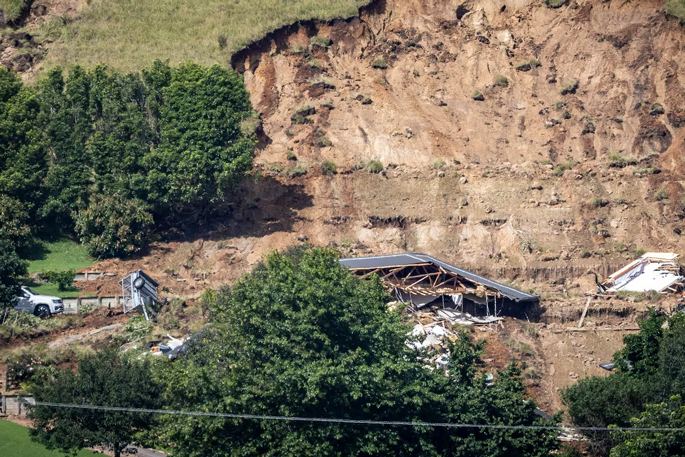
The bill to repair damage from severe storms this year is expected to reach $28.6 million in Western Bay of Plenty.
The Western Bay of Plenty District Council has released its recovery plan, aiming to guide the next phase of this work and better prepare for future severe weather events.
The plan outlined impacts of severe weather that hit the district in January, March and April.
It said in the January 21 and 22 event, parts of the district received rainfall “equivalent to a one-in-100-year or one-in-500-year event”.
 Some parts of the district received rainfall levels equivalent to a 1-in-100 to 1-in-500 year event. Photo / Metservice
The peak was 395mm in 48 hours in Tuapiro.
Slips and flooding from the storm caused damage around the district and two deaths.
Yao Fang, 71, and her 10-year-old grandson, Austen Keith Richardson, died when a landslide hit a Welcome Bay Rd home early on January 22.
In neighbouring Tauranga, six people died after a landslide in Mount Maunganui later that morning.
 Yao Fang and Austen Keith Richardson were victims of the storm. Photo / New Zealand Police
The council said four homes near the fatal Welcome Bay Rd slip were issued red placards, preventing entry. Two were later downgraded to yellow, which allowed entry with restrictions.
Initial red placards at two Ōmokoroa homes have since been replaced with yellow.
In total, 52 properties were assessed and 22 placarded during and after the event. Another four were yellow-stickered after the March and April storms.
The council told Local Democracy Reporting that 20 homes were still placarded – one red-stickered, 16 yellow and three white, which means the building is safe to reoccupy. Two assessments were yet to be completed.
Infrastructure damage
At the peak of the January event, 77 roads were closed around the district due to slips, flooding, fallen trees and debris, the plan said.
 A slip that came down over Woodland Rd, near Katikati. Photo / Sally Goodyear
Most reopened by January 30. Some needed major repairs.
One road remains closed, but residents could still reach their properties.
The weather also impacted three waters infrastructure. Slips at Waihī Beach damaged access to stormwater ponds and water reservoirs.
In Katikati, the wastewater treatment plant was overwhelmed by stormwater, causing partially treated wastewater to overflow into the wetland and harbour.
Slips within reserves damaged stormwater pipes, footbridges, public trails and other infrastructure.
 An aerial shot of the flooding around Katikati township. Photo / Dallas Meeking
Ongoing uncertainty
The plan said residents described significant damage to homes, land, roads and local businesses in community meetings held after the January storm.
The also described the “emotional strain of displacement and ongoing uncertainty”.
“Many do not yet know the full extent of land movement around their properties and asked for clear guidance on what to expect next.
“Residents told us they need better clarity about who is responsible for repairing slips, river blockages, fallen trees and damage involving multiple landowners or public agencies.”
 A slip at a Harbour View Rd property in Ōmokoroa.
Some households remain displaced and some had questions about voluntary buy-out pathways or raised insurance challenges.
The report said that in the coming months, the council would focus on completing engagement with all affected households and placarded properties, and work closely with marae and hapū.
It would finalise an infrastructure damage register, progress Government funding applications and confirm the sequencing of priority repairs so work could start as soon as resources allow.
Funding
The recovery plan document sets out an estimated cost of $28,587,907, of which the council expected to fund $15,595,840.
Transportation alone made up $21.3m of that cost, with the council expecting external sources, such as NZ Transport Agency Waka Kotahi (NZTA), to cover about $12.7m.
Reserve repairs, including at the Kaiate Falls Scenic Reserve and the Waitekohekohe Reserve, were estimated at about $4.375m.
Funding options included drawing from the council’s $9.2m contingency fund, using existing budgets, reprioritisation, loans and deferring repairs.
 A landslide in the Pāpāmoa Hills area in January.
External funding would be sought from insurance claims, NZTA and other Government agencies.
About $219,000 in donations had been distributed.
The report said the council was not a guarantor of private property interests and did not act as an insurer.
Recovery actions related to private property would focus on risk management, information provision, planning tools, and enabling informed decision-making, rather than direct financial compensation.
‘Recovery is well underway’
Western Bay of Plenty Mayor James Denyer said in a media release that the storms had a profound impact across the district, and the council’s thoughts were with those continuing to live with those impacts.
“Since the severe weather, the recovery team, council staff, contractors, iwi, community organisations, volunteers and government agencies have worked tirelessly alongside our communities to support recovery.”
 Western Bay of Plenty District Council Mayor James Denyer. Photo / Alex Cairns
Denyer said the team had supported 98 recovery cases across the district, helping residents navigate what could be a complex and challenging recovery journey.
He said the recovery plan provided a clear and practical roadmap for the next phase of recovery.
“While recovery is well underway, there is still more work to do.”
Denyer said a prioritised roading recovery programme would be published, including indicative timeframes and regular updates so communities could see what was being fixed.
Council recovery manager Jo Lynskey said recovery work began immediately after the events.
 Western Bay of Plenty District Council recovery manager Jo Lynskey.
Lynskey said the scale and complexity of the effort had required the council to reprioritise resources and pause planned work to focus on urgent recovery needs.
She said eight families remained unable to return home.
“This is a significant recovery effort for our district, and it’s important people understand the scale of work involved.”
The work took time because sites often required assessments, investigations, funding approvals and specialist design work before permanent solutions could start.
Lynskey said severe weather events were becoming more frequent and intense, and the district needed to strengthen how it prepared for future events.
“This plan helps provide that direction.”
The plan would guide work over the coming years and evolve as needed.
Ayla Yeoman is a Local Democracy Reporting journalist based in Tauranga. She holds a Bachelor of Arts majoring in communications, politics and international relations from the University of Auckland, and has been a journalist since 2022.
LDR is local body journalism co-funded by RNZ and NZ On Air.


0 comments
Leave a Comment
You must be logged in to make a comment.