


A new housing model aimed at helping retirees unlock equity without entering retirement villages or taking on debt is launching in Tauranga.
The ‘Homes Together’ model has been developed by the Bay of Plenty Housing Equity Fund (BOPHEF) and offers long-term independent living through a ground lease arrangement.
Residents make an upfront contribution of $300,000 to $400,000, which is fully refundable upon exit, and pay a modest $200 weekly ground rent plus rates and insurance.
The first ‘Homes Together’ development is currently under construction in Matua, Tauranga.
It consists of seven two-bedroom homes and three one-bedroom homes that are designed for those wanting accessible, single-level, low-maintenance living. Residents will be able to move in from September.
In a media statement to SunLive, BOPHEF investment director Peter Watson said the model was created in response to a growing number of older New Zealanders who are financially secure on paper, but have most of their wealth tied up in large family homes.
“People are locked into big houses often with 95% of their wealth stuck in one home. No cash,” he said. “They are forced to live a constrained retirement because they have no money.”

Construction of the new development in Matua. Photo / Supplied
Watson said downsizing into something that’s actually cheaper could be hard for some retirees.
He said even townhouses still cost $700,000-plus. There’s also not a lot of one and two-bedroom homes out there, and not a lot of homes that are single-level, which is important as people get older.
“Aside from going into a retirement village early, there’s not a lot of options for people. And so this is about providing a different alternative for them.”
Under the Homes Together model, residents contribute $300,000 for a one-bedroom home or $400,000 for a two-bedroom home which covers the cost of construction.
That contribution is fully refunded when they leave, while any capital gains remain with BOPHEF.
The weekly $200 ground rent is linked to the Consumer Price Index but capped at 3%.
“Retirement villages typically take 30% of your equity when you exit, and they generally won’t pay you out until they resell it. We’ll repay your full contribution after 90 days.”
Watson said the model also provided an alternative to reverse mortgages, which can leave people tied to homes that are no longer suitable for them while interest costs continue to accumulate.
“The home may become too difficult to manage as they age, but they’re locked into staying here.
“We want to help retirees gain more financial freedom.
“Under this housing model, they could potentially help their kids with a house deposit, go on overseas trips or invest their remaining equity and live off the interest. They get to spend their money while they’re alive, and live in a home that’s better suited to their needs.”
Residents would receive a registered interest on the property title, providing long-term security and certainty in the home.
People could only be evicted for breaching agreed community rules around matters such as antisocial behaviour and maximum occupancy, which were designed to maintain a harmonious neighbourhood.
Watson said the model was intended for independent living rather than those who need care.
He said each home does feature wider hallways and doorways suitable for wheelchairs, level entry access and adaptable bathrooms to support ageing in place.
“From the outside, and if you walked in, it would just look like a nice house.”

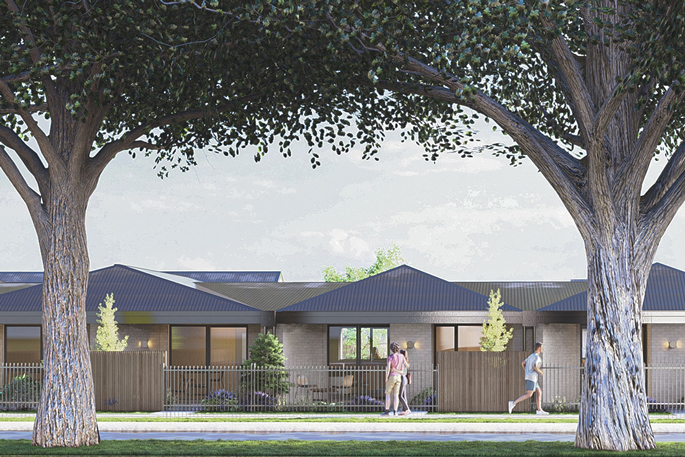
An artist's impression of the new development in Matua. Image / Supplied
Enquiries were now open for the Matua development at 299 Levers Rd.
Prospective residents are encouraged to contact BOPHEF directly for more information.
The fund
The Bay of Plenty Housing Equity Fund was established in 2024 to invest in affordable and sustainable housing solutions across the region.
It’s backed by a $100 million fund supported by Tauranga City Council, BayTrust, TECT, Trust Horizon, Rotorua Trust and New Zealand Green Investment Finance.
Watson said the wider aim was to help unlock movement across the region’s housing market by enabling older home owners to downsize while freeing up larger homes for families.
“The ideal scenario is we will attract a resident to our Matua development who wants to sell their house and land to us, so we can continue developing new homes and create more impact.”
He hoped the Homes Together model would eventually be adopted by other organisations and expanded elsewhere around New Zealand.
-Supplied content

0 comments
Leave a Comment
You must be logged in to make a comment.