


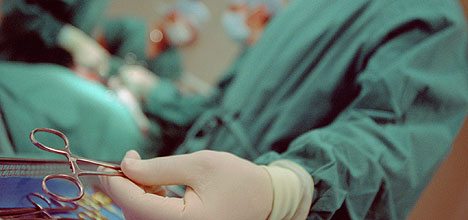
A new robotic surgical device developed over four years in Silicon Valley, USA, was trialled in a world first operation at Tauranga Hospital this week.
The connection between the two organisations is the head of the Bay of Plenty District Health Board Clinical School Associate Professor, Peter Gilling, who has an international reputation for the surgical treatment of benign prostatic hyperplasia (BPH) and works out of Tauranga.
A world first surgery was trialled at Tauranga Hospital this week.
BPH is an enlargement of the prostate gland and Peter says as many as a quarter of men older than 60 years have this condition.
Working alongside his California-based colleagues Peter performed the world-first surgery in Tauranga Hospital this week on two men.
The first to be treated was an 84-year-old Mount Maunganui man.
Peter says both men were aware they were making medical history and were excited to be part of the trial.
'They both stayed in hospital overnight and were discharged within 48 hours of admission.
'The Urology Research Team has undertaken this study in conjunction with the Clinical Trials Unit as part of the Bay of Plenty District Health Board Clinical School. BPH is a huge problem, and it is the first disease that this new technology will be attacking.”
The technology has been developed as a solution for BPH a condition that increases the size of the prostate and can cause partial or sometimes virtually complete obstruction of the urethra.
This leads to many urinary complications and discomfort.
Peter says it does not lead to cancer or increase the risk of cancer, and can be controlled with medication.
He says when the symptoms become intolerable it needs to be removed via surgery.
Most recently this procedure has been performed using thermal energy involving high powered lasers through the urethra.
However PROCEPT BioRobotics, the creators of this new technology, are hoping to change the nature of surgery by using water instead.
Peter explains this new technique cuts and cauterises using a waterjet as thin as a strand of hair and a very low powered blue light laser.
This surgical robotic device removes tissue using high pressure water with a precise and consistent fluid velocity rate.
PROCEPT BioRobotics flew their equipment over from America to undertake the operations.
'We have been working on this project for four years,” says Dr Nikolai Aljuri, Founder and CEO.
'This live trial is the most important day in the history of our company. The use of water has many benefits.
'There will be no secondary damage from heat, as there is with laser surgery, so there will be reduced complications and faster recovery time. It will also be very cost effective compared to laser surgery, as laser uses hundreds of watts, whilst waterjet guided laser only uses a few watts.”
He says the water has beautiful characteristics and is tissue selective.
'This new technology called Aquablation is a very accurate and effective way of removing tissue, which will not only be better for patients, but for urologists.”
How it works:
*The doctor takes measurements to determine how much tissue to remove and inputs it in a handheld computer.
*A robotic arm connected to a telescope is inserted into the patient.
*Jets of water carry out the rest of the operation automatically.
*A very low powered laser can be used to stop any bleeding if necessary.

0 comments
Leave a Comment
You must be logged in to make a comment.