


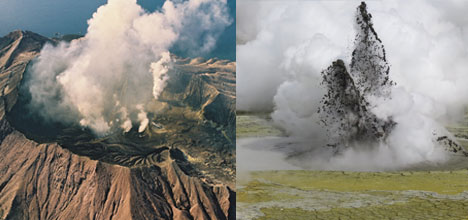
An eruption at White Island off the Bay of Plenty coastline could happen at any time, according to GNS volcanologists.
Scientists spent about three hours flying over the volcano, about 49km off the coast of the Bay of Plenty, this morning taking samples of the gases in the volcanic plume after seismic activity featuring hybrid earthquakes was recorded in the last day or so.
White Island may or may not erupt.
GNS Science Volcanologist Gill Jolly says gas level samples help indicate what is happening deeper within the volcano.
Comparative levels of sulphur dioxide, carbon dioxide and hydrogen sulphide can help scientists determine what is occurring.
'If we see a really significant increase in any of those gases particularly sulphur dioxide or carbon dioxide, that will be a bit of a warning flag,” says Gill.
A large increase in gas volumes indicates there is more magma – molten lava – in the system.
'Carbon dioxide comes out of the magma at a slightly deeper level in volcanoes, so if we had a big increase in that, it would indicate we had magma coming up from quite a depth,” says Gill.
'If its sulphur dioxide, that gas came out at a relatively shallow level so it would say that magma's really quite close to the surface, or that a batch of magma is close to the surface.”
Gill said this morning the data will need be to be analysed before it is interpreted by volcanologists before scientists can fully understand the state of the volcano.
Activity at the volcano has increased considerably since January 15, with scientists raising the Aviation Alert Level last night from yellow to orange meaning the volcano is exhibiting heightened unrest with increased likelihood of eruption.
Given the heightened alert level, Gill says a media release on any significant findings may be made over the weekend.
While the overall level of volcanic tremor is decreasing, hybrid volcanic earthquakes are appearing. Hybrid earthquakes are a mix of rock fracturing and magmatic vibration, and are taken as an indication of the movement of magma in a volcano.
Gill says it is not GNS Science's role to tell people to stay away from the island but they are just as concerned as they were during the activity in August 2012.
Where GNS staff used to spend an entire day on the volcano doing their routine monitoring, they are now there for about an hour.
'And when we are going out there we are wearing our full protective gear, helmets, gas masks and protective clothing,” says Gill.
'We would also do a fly around the volcano before we land, just to check that nothing significant is happening, and we would check the seismic records before we go to check there is no escalation in activity.”
What happens next is an open question. There is fresh magma in the system, as evidenced by the eruption in August and the lava dome extruded in November.
'Over the next few weeks it might get more active, a significant batch of more magma coming up the volcano, or like the gas venting in August or more vigorous period from 1976- 2000. Some ejected magma to the crater floor, some reached the sea.”
If gas levels are found to have increased from say a few hundred tonnes a day more a 1000 tonnes, that might indicate there is more magma coming up into the system.
More earthquakes also suggest something is pushing from below, probably magma. More heat coming through the system, either in the little lake let, or some of the fumaroles is also a magma indicator.
There could be ash eruptions, a lava extrusion – or it could just fade away to a low level of background activity.
'It's quite hard to tell which of these scenarios is the most likely, we are collecting more data on a daily basis and this will help inform those decisions,” says Gill.
'With all volcanoes there is uncertainty, a bit like trying to forecast the weather with your eyes closed. Because in order to see what's happening under the surface you are using these indicators that we are measuring and that just gives us hints and e clues, a bit like a detective story, to understand what's going on and what is likely to happen next.”
'Volcanoes tend to be fickle beasts. Often they look like they are building up to something, and then nothing happens at all.”

4 comments
BUT!!!!
Posted on 25-01-2013 17:36 | By Sambo
will we get time to erect sirens,? or wax the board?.
FRACTURE QUAKES
Posted on 25-01-2013 20:07 | By YOGI
So earthquakes are occurring where the rock is fracturing, that means that magma is on the move and the pressure is changing/increasing. Generally that will mean that sometime something will happen, the only question is when will that be. White Island is a very active volcano, time will show us what is happening now and what it will mean, hindsight is a wonderful thing.
Go
Posted on 26-01-2013 07:51 | By Capt_Kaveman
White island let it blow like never before
@ SAMBO
Posted on 26-01-2013 12:58 | By YOGI
Neither, even if the TCC staff pre determined desire of Merkat's sirens happened before hand, a Tsunami would be here in 10-15 minutes maximum. I would have the surf board ready I think, only option left really.
Leave a Comment
You must be logged in to make a comment.