


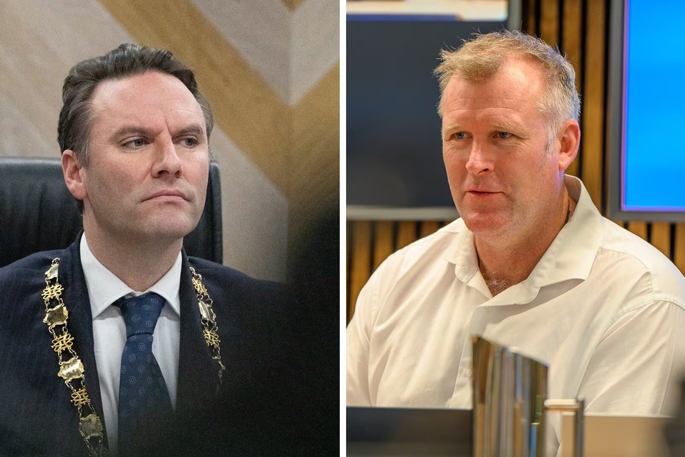
Tauranga Mayor Mahé Drysdale has welcomed the Government’s ultimatum on local government reform proposals as an opportunity for councils to shape their own futures.
His Western Bay of Plenty counterpart, James Denyer, says the announcement was a surprise and he was unsure if the three-month timeline will allow for the community to have input.
Within 90 days, the Government wants councils to pitch “reorganisation ideas” focused on creating larger unitary authorities, which merge local and regional council functions.
The “head start pathway” was announced by RMA Reform and Infrastructure Minister Chris Bishop and Local Government Minister Simon Watts in a press release on Tuesday.
“If councils don’t step up and put forward credible proposals, the Government will step in and make those decisions … lead your own reform, or we will do it for you,” Bishop said.
The goal was to have fewer, larger authorities in a simpler and more efficient system, Bishop said.
The urgency was linked to setting councils up to deliver on the Government’s new resource management planning system, expected to pass into law this year.

Minister for Infrastructure Chris Bishop. Photo / Jason Dorday
“Fixing the planning system while leaving local government untouched would just lock in the same problems,” Bishop said.
The restructure proposals must come from two or more city or district councils, and can include neighbours across regional borders. Regional councils cannot make proposals.
Western Bay of Plenty Mayor James Denyer said he was emailed a letter from Watts at 12.30pm on Tuesday. This was the same time the press release embargo lifted.
Denyer said the email “was a surprise”, as he had expected an update once the Simplifying Local Government legislation was finalised.
He told Local Democracy Reporting on Wednesday that councillors had not yet had the opportunity to discuss the proposal, nor had any formal briefings or guidance on the head start criteria.
It was too early to say if Western Bay would pursue making a proposal, he said.
Internal discussions and conversations with neighbouring councils were being arranged.

Western Bay of Plenty Mayor James Denyer. Photo / Alisha Evans
Denyer said the community would want to have input, but it was unclear if or how this would be incorporated within the timeline.
He said Western Bay was not a small council, ranking within the top 20 territorial authorities in New Zealand by population.
“There is always a trade-off between achieving potential economies of scale and effective local representation and provision of service,” Denyer said.
Tauranga Mayor Mahé Drysdale has been a prominent advocate for amalgamation between councils.
He said he knew change was coming and welcomed the Government’s proactive approach.
“Local councils now have an opportunity to lead that change, or this will be done to us.”
Drysdale said reform was needed to improve efficiency, reduce costs and deliver better outcomes for communities.

Tauranga Mayor Mahé Drysdale. Photo / Brydie Thompson
He said elected members had been voted in to represent people and make decisions.
“Our communities expect us to step up and work through the options in the best long-term interests of our region,” he said.
“For me, that means keeping local decision‑making and representation at the forefront and being proactive about how we shape that future."
He said the challenge would be achieving efficiencies without compromising local representation.
Collaboration across the region would be critical given the tight timeframe, Drysdale said.
“I’ll be advocating with my colleagues from across the region that we act with urgency and consider how we move forward together to get the best possible outcomes for our people and the region.”
Tauranga and Western Bay have already made a tense agreement to form a shared water services organisation.
Bay of Plenty Regional Council chairwoman Matemoana McDonald said on Tuesday that early discussions between councils had already started since the announcement, though no firm position had been taken.
“We have been working primarily through the Bay of Plenty Mayoral Forum, and the focus is on better understanding local government functions and improving shared services,” she said.

Matemoana McDonald, Bay of Plenty Regional Council chairwoman. Photo / Alex Cairns
McDonald said the council was taking a “function before form” approach, focusing on what services need to be delivered before deciding on structure.
She said the reform process carried significant risks if not managed carefully, particularly around environmental oversight and community safety.
“No one would want to see the safety of communities and the environment compromised by local government reform,” she said.
McDonald said the council’s core responsibilities would continue to function throughout any transition.
“Ensuring these are well planned for and continue to be delivered effectively will remain a priority.”
She also acknowledged uncertainty among staff during this “unsettling time”, but said employees “remain focused” on delivering for communities.
“At this stage, many details, including potential impacts on staff, are still unknown.”
Rotorua Mayor Tania Tapsell told Local Democracy Reporting Rotorua an urgent online meeting of Bay of Plenty mayors and McDonald was held on Wednesday night.
The ministers’ statement said officials would assess proposals from councils against criteria including feasibility, alignment with the new planning system, simplicity, value for money and community representation.
Cabinet would decide which proposals to progress later this year.
These would be developed in detail and signed off next year, with changes implemented ahead of the 2028 local government elections.
For councils that did not participate, the Government would implement a standardised backstop process to ensure reform still occurred nationwide within the same timeframe.
– Additional reporting by Mathew Nash, Local Democracy Reporting
Ayla Yeoman is a Local Democracy Reporting journalist based in Tauranga. She holds a Bachelor of Arts majoring in communications, politics and international relations from the University of Auckland, and has been a journalist since 2022.
LDR is local body journalism co-funded by RNZ and NZ On Air.


4 comments
This is…..
Posted on 08-05-2026 11:35 | By Shadow1
…outrageous! We finally managed to get rid of the Commissioners and the Three Waters debacle after years of protest and now look what’s happened. A different version of the Three Waters, pushed through with little debate from ratepayers. Our council, including the Mayor, have rolled over and accepted it without much in the way of comment.
Now Central Government wants us all to amalgamate! What! The Mayor apparently has secretly been a fan of amalgamation all the time. Well goodbye Mahi, you’re a big disappointment to me.
So why are they doing this? Do they not realise that the bigger the area councils have to represent, the less they achieve. Look at Auckland, look at Wellington, how are they doing? Yeah, bloody disasters.
Shadow1.
Does TCC really understand it's ratepayers?
Posted on 08-05-2026 13:33 | By Watchdog
To me, it all started when Tauranga Electricity Company was sold. Council had $19 million which they said they would use to repay debt.
Did that happen? No, they simply decided to spend about half of it to suddenly do up the CBD. Humps and bumps, porphory stones, and removal of hundreds of car parks, which made it less practical to park outside a shop and get packs of photocopy paper, etc. To cover that shortfall, parking buildings were installed one of which failed and cost us $5 million, an apparent total waste! Why no insurance to cover this loss, I wonder.
Then they said Oh, we are putting in water meters to every household, another $9+ million. Ratepayers squashed that idea through the use of a protest poll.
But Council, determined to get their way, got the rules changed.You lose!
No credibility.
De facto 3 waters
Posted on 09-05-2026 13:13 | By Kancho
Three waters was highly contentious and much demonstrated against. Yet this is basically the same. A lack of real expertise and qualifications and race based "appointments " on the payroll. The premiss that water is not owned will be no doubt be challenged time and money wasted . Tauranga already has good water developed and paid for by ratepayers but TCC debt and management and choices are not good and I have little confidence with this " set up "
Not going to end well like many other programmes ministered by TCC
Thirsty Morepork says: If you factor in...
Posted on 12-05-2026 14:49 | By morepork
...all of the time, energy, argument, and conflict, leading to a thinly disguised and already rejected 3 waters solution, how much has this cost us, so far (before we even start the work on it)? How much will it have cost us when it is finally delivered? Who will take responsibility when the first seasonal drought bites and we are back to water rationing?
For less than $100 million we could have had a desalination plant providing around 70,000,000 litres/day. (Tauranga uses an average 60,000,000 litres/day, currently.) Water rates would NOT have to rise for this plant to pay for itself in 5 years. If you are REALLY politically driven towards amalgamation, the partners could chip in and expand this plant so it can provide a greater volume. In combination with the existing delivery, and sharing reticulation, water sourcing for the region could be GUARANTEED 100years.
Leave a Comment
You must be logged in to make a comment.