


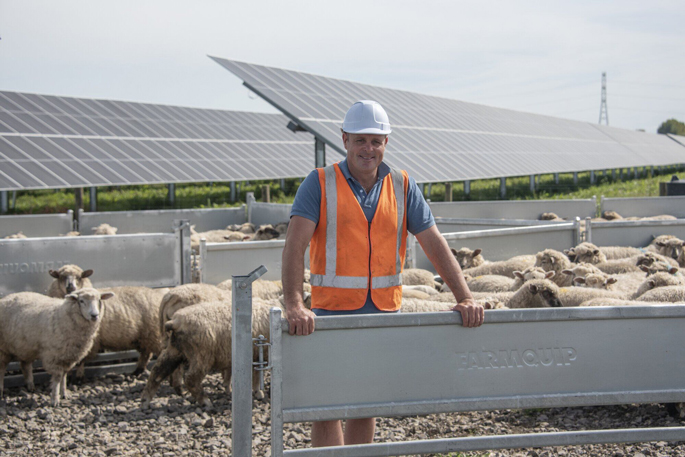
While standing in the middle of the 50-hectare Rangitaiki solar farm near Edgecumbe, the most noticeable thing is the peace and quiet.
Sheep graze in the sunshine and snooze in the shade from the solar arrays, birds flit between the arrays and the hawks circle overhead, all against the magnificent backdrop of Pūtauaki (Mt Edgecumbe).
After acquiring the Rangitaiki site, Lodestone Energy started construction in 2023 with the first generation in March 2024.
It produces an average of 49 gigawatt-hours of energy, enough to power 7000 residential properties a year.
Electricity is contracted to several commercial customers, with future farms earmarked for a residential solar-backed offering.
“The location choice for a solar farm is decided by a number of factors,” says Lodestone Energy chief operating officer Richard Pearce.
Richard says flat or slightly undulating land in an area of great solar radiance, with stable soils, and close proximity to an existing electricity network with available capacity are top considerations.

Sheep grazing at the Rangitaiki Solar Farm with Pūtauaki as the backdrop. Photo / Catherine Fry
Before building the farm, risk assessments are carried out for earthquake and flood activity, hail and high-wind events.
Environmental factors
The solar arrays, a collection of solar panels working as one system to produce power, have a life expectancy of 30 years and are sourced from China.
The solar panels are primarily made from polysilicon, glass, silver, aluminium, and other trace minerals. Up to 95% of these materials are recoverable through dedicated recycling facilities in Australia.
Richard believes that by the time Lodestone’s panels are due for renewal, New Zealand may also have this capability.
“Solar technology is improving rapidly. The panels installed at Rangitaiki in 2024 are rated at 545W each. Just two years later, we can source panels of the same physical size delivering around 640W,” Lodestone Energy asset and operations manager Dave Smith says.
“This means more solar electricity is generated from the same area of land.”
Dave says the impact of solar farming is low, using no water or fuels, no run-off implications, no byproducts, and minimal noise and visual impact.
“The soft whirring when the solar arrays self-adjust to track the sun goes unnoticed by the animals and birds, and it’s hard to believe you are amidst a power-producing facility.”
The arrays use bifacial panels, generating electricity from both the front and back of the module. The front captures direct sunlight, while the underside captures reflected light from the ground, typically increasing energy yield by around 5-10%.

Lodestone Energy operation controller and production engineer, Darren McGrath (left), asset and operations manager Dave Smith and chief operating officer Richard Pearce at the Rangitaiki Solar Farm. Photo / Catherine Fry
Mounted tracking systems follow the sun from east to west throughout the day, maintaining the optimal angle for generation.
Bifacial technology and tracking systems can increase energy production by around 30% compared to traditional fixed rooftop installations.
Rain washes most bird droppings and pollen off, with spot cleaning maintenance required from time to time for damaged or heavily soiled panels.
“Thermal drones flown over the 50-hectare site carry out thermographic inspections much faster than manual inspections of the arrays and highlight any issues with the 59,000 panels by showing hotspots,” Dave says.
“Following successful trials of remote deployment at our Waiotahe Solar Farm, Lodestone is rolling out docked drone systems across its sites to inspect assets after weather events.”
During high winds, the arrays automatically stow parallel to the ground, minimising potential damage.
Dual use land
Dave explains that the site features agrivoltaic design, allowing machinery to operate and livestock to graze on the farmland underneath and this is one of the most exciting aspects of the farm.
“Maintenance of the vegetation under 50ha of arrays is a costly but essential exercise as out-of-control vegetation could present a fire hazard,” says Dave.
“Grazing sheep on the site has proved to be a win-win solution for all concerned, especially because it keeps good farmland in use.”
Farmer Ben Parsons leases 45ha of grazing under the Rangitaiki solar arrays.
He runs 850 to 1200 sheep, depending on the time of year, buying in lambs and finishing them, aiming for two cycles a season. It is an opportunity for him to build a stock-owning business without land ownership.

Grazing sheep keeps vegetation down and the solar arrays offer shade for the sheep at the Rangitaiki Solar Farm. Photo / Catherine Fry
“We initially let them loose on the whole 45ha, but they didn’t do a very good job keeping the vegetation down, so we fenced 10 4-ha paddocks and rotate the paddocks. This effectively manages the vegetation and the effluent load from sheep is lower than cows,” Ben says.
With the cost of owning land being so high, this is ideal for the farmer, the solar company and the environment, ensuring the land is looked after into the future.
Richard notes that solar farming is among the lowest environmental impact energy sources, delivering some of the lowest-cost electricity (LCOE) available today. However, he emphasises that a mix of generation technologies, including solar, wind, hydro, geothermal and thermal, is essential to keep New Zealand’s electricity system reliable and resilient.

1 comment
WIN WIN!
Posted on 08-05-2026 13:07 | By Watchdog
Seems like a thoroughly good use of the land with many safeguards and features built in.
It's a win win for the operators and farmers. Like a symbootic relationship.
Leave a Comment
You must be logged in to make a comment.