


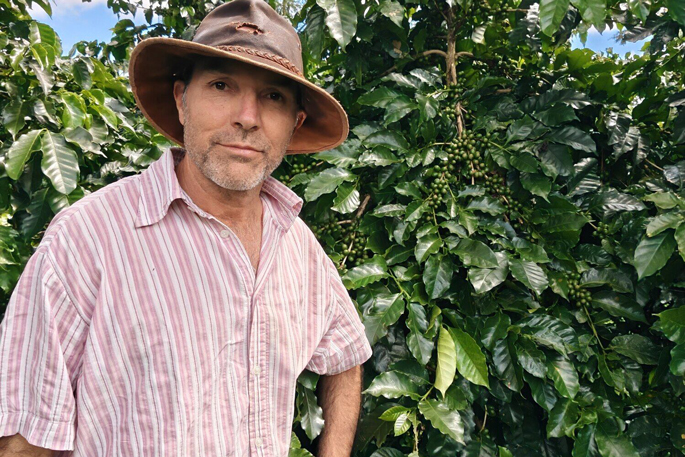
A cross-pollination of ideas, blending coffee growing in Africa with New Zealand horticulture, has germinated on the Hauraki Plains.
Luke Powell, owner/operator of Kasama Coffee in Zambia, recently spent time at Turua with commercial fruit and vegetable grower and Environmental Fertilisers’ general manager Grant Paton.
The pair had been communicating from across the world for the past five years, with Luke coming to New Zealand to seek out Grant and in particular to discuss their shared interest in Reams Biological Theory of Ionization (RBTI).
This is a holistic health approach developed in the mid-20th century that views the human body not just as a collection of organs, but as a complex energy system – essentially, a living, breathing chemical battery.
“He talks my talk,” says Luke of his association with Grant during the week-long visit.
“It was great talking about soil stuff applicable to Zambia,” says Grant, who runs a 3.2ha property that features a 40m x 30m fruit and vegetable patch, with the balance hosting beef cattle.
Back home, 55-year-old Luke runs Kansato Farms, the producer of Kasama Coffee, in the northern province of Zambia.
His father was gifted the 350ha property by a local tribal chief in the 1980s, developing a market garden of vegetables, plus poultry, and 0.4ha of coffee trees for home consumption.
Luke took over the operation in 2000 and, seeking a high-value crop that neighbouring farmers were not growing, planted 30ha in coffee. The balance is used for commercial timber and poultry.
Coffee beans at Kansato Farms are picked by hand from May to September.
“When they are red they are ready,” says Luke.
They are washed and dried for up to 12 days, when the moisture content reaches 12%.
Skin recycled
The skin is then removed and used for bedding for chickens in Luke’s commercial egg operation on the property.
In return, chicken droppings help to fertilise the coffee plants.
The coffee beans are hand-graded, then roasted for 17 minutes.
Luke says they can be ground on-site – in a stone flour mill – or sent away as whole beans.
Packaging is also undertaken on the home farm.
Luke has 50 people on the payroll, which swells to more than 100 during the harvest season.

Part of the coffee plantation on Kansato Farms in Zambia. Photo / Supplied
“Kasama Coffee stands as a beacon of ethical farming and job creation.”
The coffee is grown using regenerative techniques and minimal machinery, prioritising employment over automation.
From handmade packaging to artisanal roasting, Luke says every aspect of Kasama Coffee embodies sustainability.
“We’re not just growing coffee – we’re creating livelihoods and protecting the environment.”
The coffee’s cloth bags are sewn locally, a project that started with a single tailor supporting orphans and has now evolved into thriving small businesses.
Kansato Farms also uses compost-based soil enrichment and integrates native tree species, preserving biodiversity and reducing reliance on chemicals.
The finished product goes into local supermarkets, restaurants and cafes, and for export to South Africa and Germany.
Export auction
The export side of the business is handled by the Zambia Coffee Growers Association, selling the product via auction.
A global recession resulted in many growers “pulling out” of coffee and going into wheat and soybeans, says Luke. “But it’s come back with more growers, predominantly in the north.”
When speaking to Coast & Country News from Turua, he joked that altitude – his property is 1350m above sea level - and frosts would prevent coffee growing in New Zealand.
“It might work on the slopes of a volcano, maybe Tongariro.”
Luke was born in Zambia and went to university in England, studying mechanical engineering and business management.
He then worked in Switzerland for 13 months in research on optimising gas turbine blades for electric power stations.
Returning home to Zambia, he sold tyres and steel before going on to the family farm.
Kasama Coffee recently entered into a partnership with commercial airline Proflight Zambia.
The collaboration marks a strategic move in aligning aviation with sustainability.
“More than ever, travellers want to know that their journey has a positive impact,” says Josias Walubita, director of flight operations at Proflight Zambia.
“Kasama Coffee isn’t just any coffee – it’s a story of sustainability, community impact and Zambian innovation.”

Bagged coffee. Photo / Supplied
He said the airline’s partnership with Kasama Coffee ensures that tourism benefits flow directly to rural communities.
Luke’s partner Stephanie Gabrielle, who is Montessori-trained, owns and teaches at her local primary school, catering for more than 200 children.
They have three adult children.
One son is 160km away managing a commercial seed potato operation, while the other is learning to be a beekeeper in Japan, and their daughter is in China teaching English and studying the local language.
Luke is not sure if any will follow in his footsteps on Kansato Farms.
“We will see what direction they take.”

0 comments
Leave a Comment
You must be logged in to make a comment.