


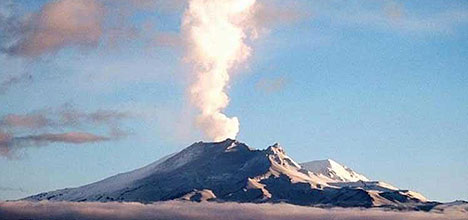
Central North Island volcanoes continue to concern volcanologists while DOC is coming under increasing pressure to re-open the Tongariro Crossing, closed following the eruption at the mountain's Te Maari crater in November.
The crater is within three km of the track down the mountain's northern face. The track is currently open from the Ngaruahoe side and only as far as the red crater near the summit.
Steam has continued to rise fron Tongariro since its eruption in August.
'We still think that the volcano is in a heightened state of unrest, there is still the potential for an eruption similar to what happened in November,” says GNS volcanologist Craig Miller.
'We don't know exactly when that is going to happen. It's quite likely that if it does it again there won't be any particular warning beforehand. It could be in that state for several more months. That's what we are saying.”
The mountain erupted on August 6 after lying dormant for more than a century, and again on November 21.
There was an alert broadcast in the weeks before the first eruption because of increased earthquake activity, but the second eruption gave observing scientists little warning.
A continuous steam and gas plume has been a feature of Tongariro since the August eruption. The gases are venting from a large fumarole and crack in a cliff just east of the Upper Te Maari crater. The main Upper Te Maari crater is also venting gas but at a lesser rate.
The emissions are on-going and sustained and are expected to be a feature of the mountain for several years to come.
Meanwhile volcanologists will be revisiting Ruapehu this week to take further measurements.
'Ruapehu is still in the state we warned of last year,” says Craig. 'We will probably be putting more information out about that later this week.
'It is still in the state where it's got this funny temperature thing happening. That hasn't really changed.”
GNS Science advised in December that Ruapehu remains at a heightened level of unrest and that an eruption is more likely than normal.
Higher than normal temperatures beneath the Crater Lake are thought to reflect a partially sealed zone a few hundred metres beneath the lake which might be causing a pressure build up behind it – which would make an eruption more likely.
A sudden failure could cause an eruption with little or no warning, but if it fails gradually an eruption is less likely. Eruptions in 1988, 2006, and 2007 are believed caused by a sudden failure of a seal beneath the Crater Lake.
But small earthquakes recorded three-five km beneath the Crater Lake in late-October and early-November have ceased. It is unclear if the earthquakes and the high temperatures estimated a few hundred metres beneath the lake were related.
Volcanologists say they never have the whole story and describe assessments as, 'detective work without all the clues.”
Visitors are to keep clear of a two kilometre zone around the Crater Lake.
The safety measures are affecting some local tourism businesses and the truncated crossing walk forced DOC to close the Maungatepopo access way before Christmas.
Before the crossing was closed people would be dropped off at the Maungatepopo car park at the Ngaruahoe end, and picked up at the Ketetahi car park on the north face. Closing the track past the lakes and down past the Ketetahi hut resulted in parking problems at Maungatepopo.
"It's become a destination so in the end total anarchy broke out with cars and buses," says DOC Ruapehu manager Jono Maxwell.
"There were wing mirrors being knocked off and cars damaged as well as people trying to park in incredibly stupid places."
The Volcano Alert Level remains at 1 and the Aviation Colour Code remains at Yellow.

0 comments
Leave a Comment
You must be logged in to make a comment.