


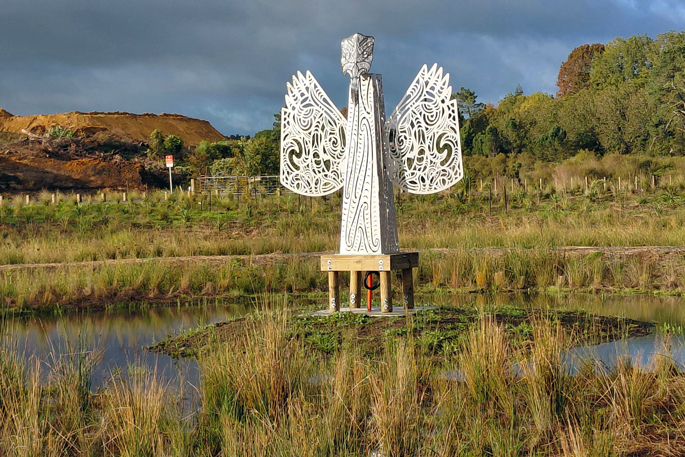
A newly installed sculpture at the Wāhi ō Waipapa Wetland in Ōmokoroa invites people to connect with the taiao (environment) and reflect on their role as kaitiaki (guardians) of the landscape.
A new public sculpture celebrating Pirirākau’s enduring connection to land and water has been unveiled at a purpose-built wetland in Ōmokoroa.
Designed by renowned artist Que Bidois and engineered by Teia Dunster, Te Hokinga Mai o te Kākā stands at the heart of Wāhi ō Waipapa Wetland, a site created to enhance biodiversity, manage stormwater and provide a new shared space for the growing community.
Tracing the migration from Tūhua (Mayor Island) to Kirikiriroa (Hamilton), the sculpture represents the flow of knowledge.
Water pouring from the bird’s waha (mouth) is its reo (voice) - a reminder that when the water is healthy, the language of the land remains strong.
The central post represents water as the lifeblood of the land, with the swirling pūhorowai patterns mirror the currents of the Waipapa River.
Embedded in the wings are pātiki (flounder) and tuna (eel), highlighting the sacred bond and interconnectedness between the people, land and water.
“The kākā is more than a bird; it is a messenger and kaitiaki, carrying the wisdom of the past into the hope of the future. This sculpture reminds us that the health of the environment is inseparable from our own well-being. By listening to the language of nature, we honour our whakapapa and our collective responsibility as guardians,” Bidois said.
A shelter with a table and seating overlooks the sculpture, and the space as a whole serves as a contemporary marae ātea - a place for people to meet, share stories and strengthen community bonds, he added.
“It is a dedicated space for whānau and visitors to connect through kōrero [conversation]. Just as the kākā is a communicator, the area encourages the sharing of ideas and strengthening of social bonds.”
The Wāhi ō Waipapa Wetland, at the end of Prole Rd, is part of Western Bay of Plenty District Council’s Prole Rd urbanisation project and is designed to enhance local biodiversity while providing stormwater management.
Linking to the Pahioa cycleway, the wetland reserve also includes boardwalks, a drinking water fountain, public toilet, bike repair station and bike stands.
Named by Pirirākau hapū, “Wāhi ō Waipapa” pays homage to the Waipapa River, a historically significant waterway for Māori communities, used for safe navigation and transportation of waka.
Pirirākau facilitated the cultural design and the wetland planting, which was done in collaboration with Matakana Island Nursery.
“We are proud to see our cultural values reflected in the design and planting of Wāhi ō Waipapa,” Pirirākau’s project manager Julie Shepherd said.
“This space is a celebration of our connection to the land and water, and we hope it encourages everyone who visits to slow down, learn from the environment, and feel a sense of responsibility as kaitiaki.
“It’s a place where people can connect with nature and each other, while reflecting on their own role in caring for the land.”
The wetland is an example of how urban development can work hand-in-hand with the natural environment, Western Bay of Plenty District Council infrastructure growth and delivery manager Annelie Badenhurst said.
“Whether walking, cycling or spending time with whānau, the wetland provides another space for the Ōmokoroa and wider community to enjoy. At the same time, it helps manage stormwater, support wildlife and keep the local environment healthy for generations to come.
“We would like to thank Pirirākau for guiding the design and planting, ensuring the wetland reflects cultural and environmental values for everyone to connect with.”
- Content supplied by Western Bay of Plenty District Council

1 comment
How much? Who pays?
Posted on 18-04-2026 08:18 | By Imhotep
Lovely story and I'm highly supportive so long as ratepayers didn't contribute to the cost of the sculpture - who actually paid?
Leave a Comment
You must be logged in to make a comment.