


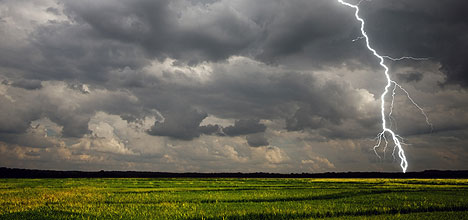
If you are gazing skywards this summer and notice menacing, cauliflower-like clouds billowing high, put the washing on hold and bring the dog inside – a thunderstorm might be on the way.
Thunderstorms can occur anywhere in New Zealand at any time of the year, according to the National Institute of Weather and Atmosphere.
Weather conditions have to be right for a thunderstorm to develop.
Dr Mike Revell has been studying the intricacies of the atmosphere for nearly 40 years. He says summer thunderstorms occur with deep Cumulonimbus clouds typically extending from about a kilometre above the surface, up through the troposphere (the lowest layer of the atmosphere) to a height of 10 kilometres or so.
Thunderstorms normally develop on a warm, humid summer day, when heat off the land begins a process of transforming a serene morning sky into a spectacular tumult by mid-afternoon.
NIWA says in New Zealand, the conditions that favour summer thunderstorm formation occur inland most often and over high ground.
The North Island's Central Plateau and ranges, the upper Canterbury plains and the South Island high country are prime breeding grounds.
At other locations, such as Auckland, local sea breeze convergence plays a key role.
Mike says a number of key ingredients are required for a thunderstorm to develop.
'Often the sun's heating of the land is enough. The warmed land heats the air immediately in contact with it and, as we learned at school, warm air rises. This is known as convection.
'There are other common lifting mechanisms too, like breezes converging from different directions.
'When that happens, there's nowhere for the air to go but up. An advancing cold front, or a breeze blowing over a hill, might also start the process.”
Summer thunderstorms in New Zealand are commonly triggered by a combination of these mechanisms.
Mike says the convection process begins when the sun rises and starts to heat the land surface.
'Then, depending on atmospheric conditions, the thunderstorms are ready to break by about mid-afternoon. They can last well into the evening – normally as a result of new cells continually replacing decaying cells, rather than a single, long-lived storm.”
Mike says people should look to the summer skies for the tell-tale signs of thunderstorm development.
'It's not often you get to watch the complete cycle of wild weather evolving from beginning to end. A summer thunderstorm is natural theatre on a grand and spectacular scale.”

0 comments
Leave a Comment
You must be logged in to make a comment.