


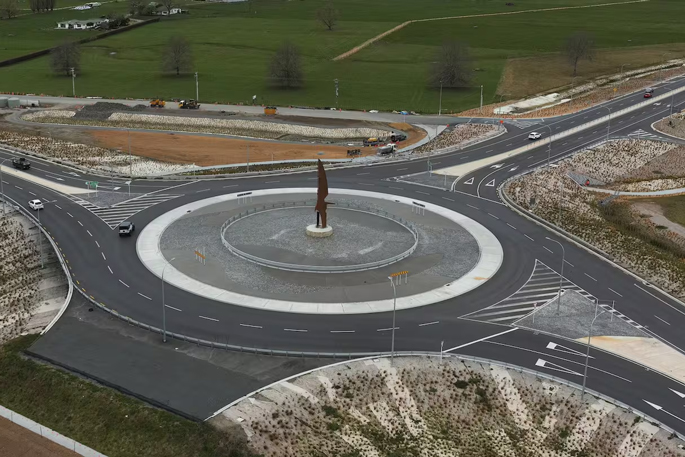
The main construction of the Piarere roundabout has been completed, after several years of calls from the community to make the T-intersection in South Waikato safer.
NZ Transport Agency Waka Kotahi (NZTA) began construction of the 60-metre roundabout on the intersection of SH1 and SH29 in January last year.
The project cost $57 million, including investigation, design, consenting and property, as well as $43.2m for the construction.
The roundabout opened to traffic in September 2024 with two temporary approach roads in action, while work continued on the three permanent approaches.
Two of the three permanent approach roads (SH1 from Tīrau, and SH29) opened to traffic in December 2024.
While “minor” finishing touches, including surfacing and line marking, would continue through the summer sealing season, the main work had now officially been completed, NZTA said.
NZTA acting regional manager of infrastructure delivery, Darryl Coalter, said the intersection had been the scene of many serious crashes.
“A roundabout was chosen for its proven safety benefits and network resilience. It was also designed with a fourth ‘stub’ to futureproof the connection seamlessly to the planned Cambridge to Piarere expressway.”
The agency estimates that more than 20,000 vehicles use the intersection daily.
NZTA first announced plans of a roundabout at the site in 2021.
Downer was awarded the construction contract in late 2023. Earthworks started in early 2024.
To make way for two pedestrian underpasses, the ground level needed to be raised 4.5 metres, which meant moving 100,000sq m of structural fill.
Downer project manager Craig Lingard said at its peak, up to 7000 tonnes of fill was delivered daily via roughly 130 truck trips.
Lingard said more than 400 people were inducted to the site and over 110,000 hours of work were logged.
The team worked with local mana whenua throughout the project.
At the centre of the roundabout is a 12-metre-high sculpture called Manu Rangimaarie (bird of peace), designed by the late Fred Graham, which celebrates the connection between hapū and iwi to the land and river.

6 comments
Job Well Done
Posted on 16-09-2025 14:53 | By Yadick
Had an appointment in Hamilton last week and had to go through this intersection. It is so, so much better than what it was and done with minimal road cones and disruption.
I did notice however, signs of at least 3 separate accidents already. It proves that roads don't cause accidents but rather self-centered and inattentive drivers do.
A good start...
Posted on 17-09-2025 08:31 | By groutby
....to the improvements along SH1 and will be so much better as the dual carriageway project continues towards Hamilton in the near future.
Although this will doubtless improve traffic flow and safety at this (previously) intersection, maybe an arrangement including on/off ramps would have been preferred so as not to slow traffic at all...bur perhaps cost was part of the decision, nonetheless, it is very welcome :)
Why??
Posted on 18-09-2025 12:14 | By hostile
Why isnt there a run off lane from Hamilton to Tauranga so traffic can freely flow through without having to clog up the roundabout?
Slipways
Posted on 18-09-2025 13:51 | By Thoughtful
While I am no traffic planner would it not have made more sense to have one or more slipways, particularly for traffic heading from Hamilton to Tauranga, but also from Tirau to Hamilton, to avoid cars having to navigate the roundabout?
Why?
Posted on 19-09-2025 07:53 | By Carol
Why is it in today's world that we see wasted funds on all these bits of metal aka status added inside round abouts or added close to them? Seems a waste of money, I don't think anyone is going to stop and look at them, round abouts used to be planted out with plants and they worked fine the way they were. It seems like a new road now needs a hunk of metal added unnecessarily and some look rediculous
@Carol
Posted on 19-09-2025 22:35 | By This Guy
Why does it need to be planted out with plants? Seems a waste of money, I don't think anyone is going to stop and look at them... (Also, plants would require ongoing maintenance, which would cost even more money)
Leave a Comment
You must be logged in to make a comment.