


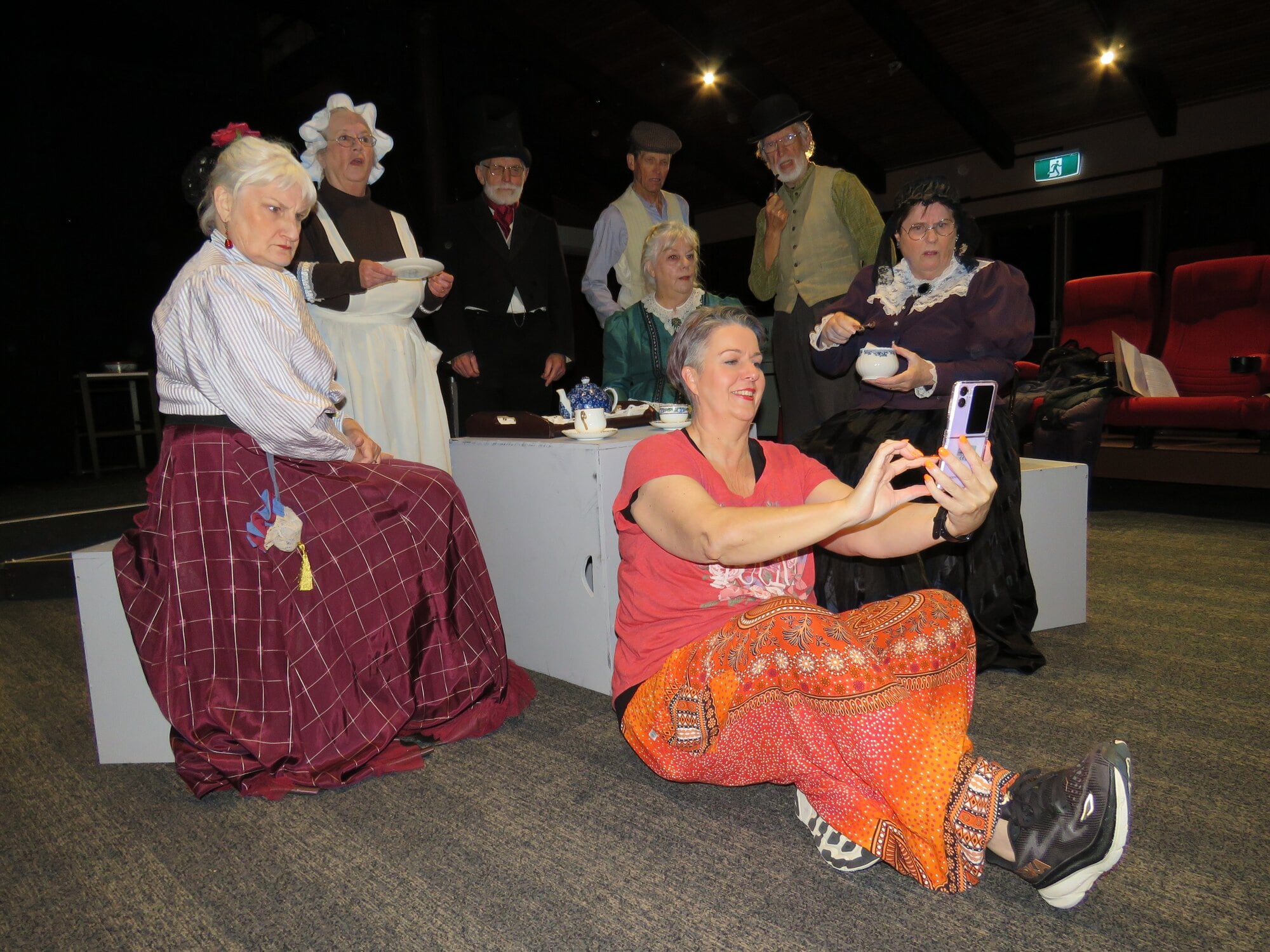
A unique way of travelling back in time to mark 150 years since the Ulster Irish settlers arrived in Katikati back in 1875 is on offer to the community this month.
Katikati Theatre’s new play – ‘The Longest Journey’ – opens at the Arts Junction next Friday, September 19 at 7pm – the first of six performances between then and September 27.
Katikati Theatre’s Julie Thomas, Di Logan and Francis Young have spent much time writing and forming the play – which comes to life as part of this month’s events to mark 150 years since the arrival of Katikati’s Ulster Irish settlers.
The plot follows seven Katikati settlers, who travel from the 1870s – when they first arrived here – through time and space in a special time machine to reach the present day.
Muriel from Woolloomooloo
“We’ve got this Australian tourist – called Muriel from Woolloomooloo – who is looking at the murals in town and it just so happens a time-travelling machine arrives and seven settlers step out of it and are astonished at the changes to the town,” said Thomas.
The settlers include George Vesey Stewart, played by Norm Guenter, known as founder of Katikati’s No 1 and No 2 Settlements; Adela Stewart, played by Di Logan, who was married to GVS’ younger brother Captain Hugh Stewart, who built Athenree Homestead; Sam Middlebrook, played by Ron Thomas, a guide to GVS when he inspected land for settlement; William Gray, played by Barry Magowan, who planned and built roading and was a Tauranga County Council member; Grace Fletcher, played by Eryl Raymond, who came aboard the Carisbrooke Castle with husband Thomas; and Mary Bell, played by Julie Thomas, an unofficial town publican thanks to son Willian Bell holding the licence.
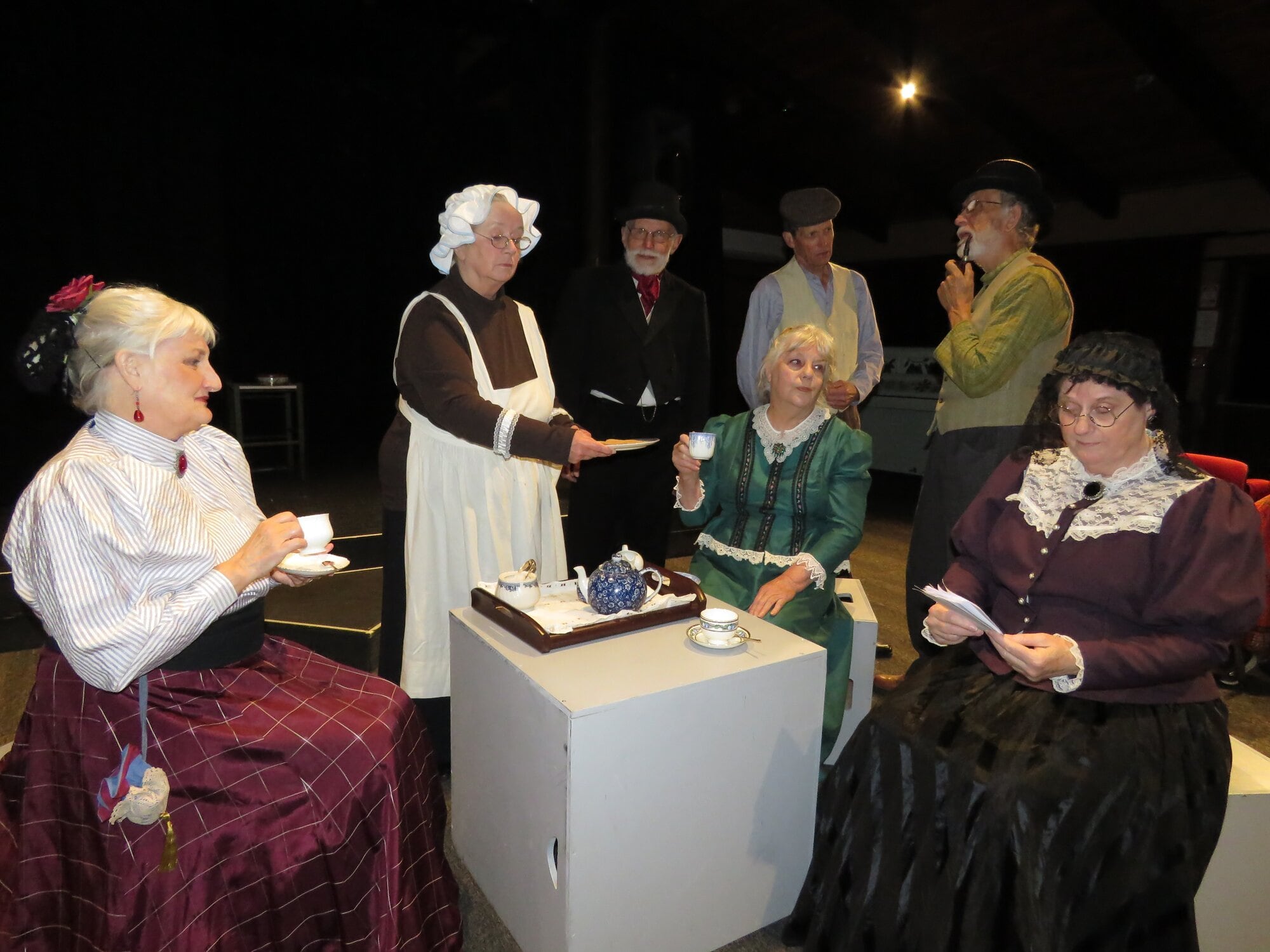
: From left Mary Bell (Julie Thomas), Maid Flora (Jean Eltringham ) and fellow Irish settlers George Vesey Stewart (Norm Guenter), Sam Middlebrook (Ron Thomas), Adela Stewart (Di Logan), William Gray (Barry Magowan) and Grace Fletcher (Eryl Raymond) in rehearsal. Photo / Merle Cave
“The only settler we’ve invented for the play is the maid Flora, played by Jean Eltringham – plus Aussie tourist Muriel, played by Fi Gudsell,” said Thomas. “Plus, we have the professor, played by Francis Young, who offers explanations to settlers as they discover a very different life in 2025.”
Mary Bell
Thomas said her character Mary Bell is the one Katikati knows the least about. “We know she was a publican – but we can’t find a photograph of her, and know little about her. We know she didn’t come with the original settlers but we don’t know when she arrived.”
Nevertheless, Mary Bell and the other ‘settlers’ dressed in clothing of the day – thanks to costume designer Annamarie Gudsell – with their accents and verbal prose showcase Katikati’s early days juxtapositioned against the town we know.
Thomas said the settlers have come “to try and sort our current day transport problems out”. That’s where the bright orange road cones, come in.
“Well, the roads were atrocious back then – it took a long time to get around from place to place,” said Young, in reference to the muddy surfaces that horses and carriages would navigate in 1875. “And they are still atrocious now – just in a somewhat different way,” said Young.
“So the play is a blending of the old the new,” said Thomas. “We have characters who are astonished at things like modern technology, traffic lights, trucks and transport, down to iPhones where one actor quotes: ‘How can that little black box know what’s going on?’”
Plus, many things we take for granted today that the settlers didn’t have in 1875 are highlighted.
Crossed wires
The cast, who’ve been rehearsing since early-August, say the play is full of comedy thanks to “a lot of misunderstandings, misconceptions and crossed wires”.
“We’ve had so much fun creating this for the community,” said Thomas. She and Logan will give the town a taste of the play this weekend – via a skit at the Settlers’ Dance on Saturday night.
“The skit revolves around Grace Fletcher’s piano, which was brought with her from Ireland. It provided a lot of the music for the settlement of the day,” said Logan.
“She used to let James Lockington collect it and put it on his dray and he’d take it around the town for events. The bumpy roads would have left it very out-of-tune but they didn’t care because it was music – and they’d have a good old knees up and a shindig.”
The actual piano will be stationed at the Arts Junction for this weekend and the rest of September – on loan from Western Bay Museum.
Thomas, Logan and Young are behind many plays brought to life by Katikati Theatre, but the trio agree this one – which captures an essence of the town’s early days and settlers – is special.
History alive
“All three of us – because of our interest in history and our love of drama – [we think] it’s a fabulous way of bringing history alive,” said Thomas.
“It even makes me think of things of how the settlers lived or what little they had at their disposal. For example, all they had for musical entertainment was a piano – or that having afternoon at someone’s house would have been a highlight.”
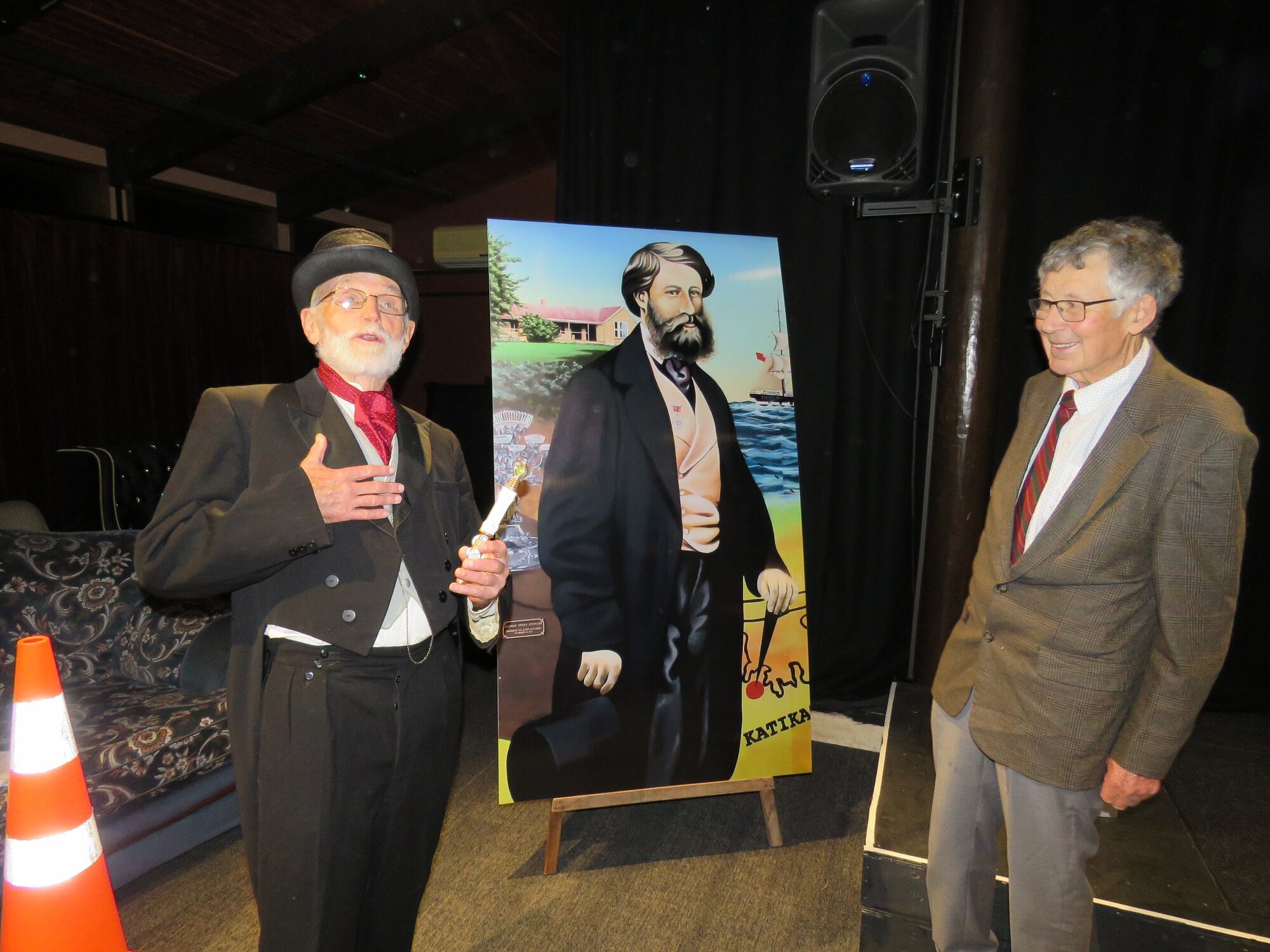
George Vesey Stewart (Norm Guenter) in front of a mural of himself circa 1875, with the professor (Francis Young) in today’s world. Photo / Merle Cave
Annamarie Dixon said the costumes truly represent what settlers of the time wore. “The settlers of this area didn’t wear the fashion you see advertised back then. They were real women in settlers’ times. They brought their clothes with them because there was no cloth manufacturing here,” said Dixon. “For me, it was tricky trying to hunt down the exact look.”
Logan said there was no concession as to what the weather was like in New Zealand when the settlers brought their clothes from back home. “The fashion was right up to the neck and down to the ground – and fact that there was mud everywhere and no roads and it was boiling hot sometimes made no difference.”
Thomas said Dixon had done a wonderful job sourcing the costumes “and that’s why you can see this wonderful contrast between free and easily-dressed Muriel the Aussie tourist compared to the settlers.”
Katikati Theatre presents ‘The Longest Journey’ between September 19-27 – at the Arts Junction, Main Rd, Katikati. Tickets cost adults $20, children $10, family concession $50, from: www.theartsjunction.org.nz/katikati-theatre-tickets

0 comments
Leave a Comment
You must be logged in to make a comment.