


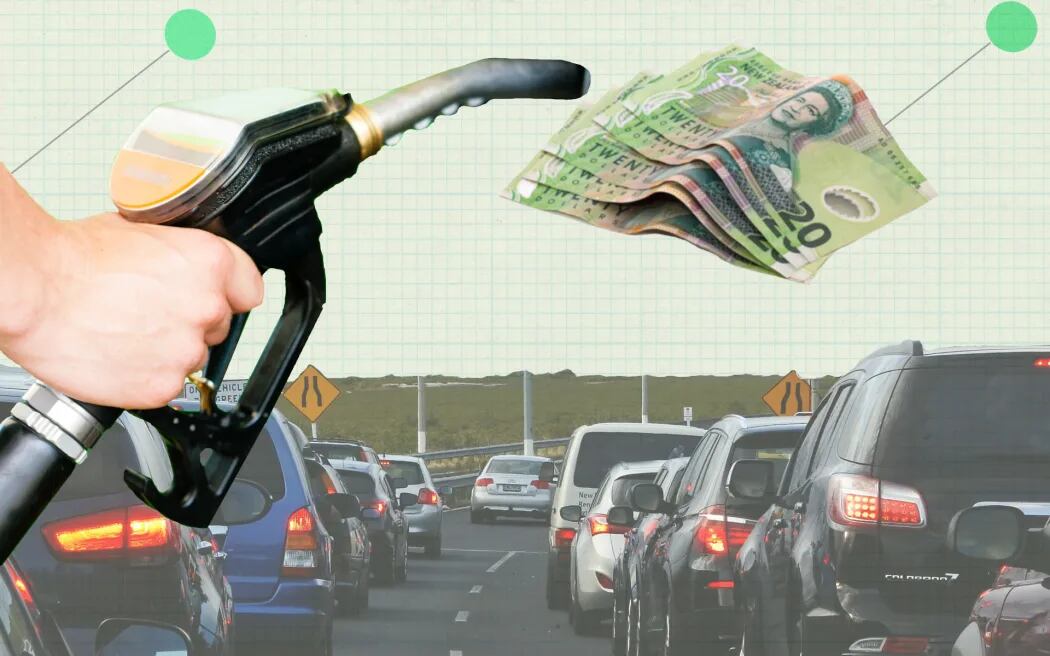
Private companies will need to keep the costs of running the Government’s new road user charges scheme as low as possible, the AA says.
The Government is inching closer to replacing petrol tax with electronic road user charges on all light vehicles, in what Transport Minister Chris Bishop calls the biggest shake-up of road funding in half a century.
He says it’ll be fairer and will be like paying a power bill or Netflix each month and will be in place by 2027.
The changes will put an end to the existing two-tier system, where petrol users pay a fuel excise duty of about 70 cents a litre at the pump, while diesel, electric and heavy vehicles pay paper-based road user charges (RUCs) based on distance travelled.
However, Labour says the timing of the coalition’s transition to a universal road user charges system risks “clobbering” motorists with more costs.
AA’s policy director Martin Glynn said his organisation is also worried about how much motorists would have to pay under the new scheme.
He told Morning Report he was unsure if it would be more expensive.
At present the minimum road user charge kicked in once a light vehicle had travelled 1000km.
That was $76 and $12-$13 for an administration fee.
With private providers being brought in to run the revised scheme, they would need to be making money, Glynn said.
“We really want to see the administration costs be as low as possible.”
He agreed with the minister that with more vehicles becoming more fuel-efficient, the current petrol tax penalised those with older vehicles.
“It’s become more unfair over time and it’s going to become more unfair if we don’t change.”
The current system of buying RUCs was “a bit clunky”, he said.
Those using diesel or a heavy vehicle purchased RUCs online from NZ Transport Agency or they could go to an agent.
Motorists needed to keep an eye on their odometer to ensure they stayed up to date.
The other problem was the RUC certification came in the mail and needed to be displayed on the dashboard.
AA supported Bishop’s plan to make the system fully electronic.
Annual warrant of fitness checks were the main way to ensure compliance at present.
“But it’s fair to say it’s difficult to enforce, being an annual system, so there’s a fair degree of evasion and avoidance and that’s something that will have to be addressed in the transition.”
Heavy vehicles already have an ERUC, a device in the trucks that monitors kilometres and location.
-By Morning Report of RNZ

5 comments
"O Brave New World...
Posted on 08-08-2025 15:52 | By morepork
...that has such idiots in it." (Sorry, Will...)
"The technology's not quite there yet..."... "It's a bit hard to enforce"...
We'll farm it out to private companies and tell them not to make too much money from it.
[Sounds like "Plan B" to me... - As Stargate's Col. Jack O'Neill once remarked: "When did Plan B EVER work?"]
WHEN you have a unit for ALL vehicles that does what we currently do for trucks (ERUC), THEN you might think about the fairest way to tax road users.
If the units can transmit their data, it should be possible to fully automate the whole process and you won't even need private companies to run it...
The Master
Posted on 08-08-2025 18:06 | By Ian Stevenson
EV's are free loading and always have been, about time that they paid a fair share of the cost burden.
For cars generally, EV's are actually heavier that a petrol vehicle, so d more damage than the average cost effective reliable car does. I hope also that the Government introduce a fire tax also for EV's as the fire that naturally just erupt from them are really dangerous, bad and require special gear to out out, if they can be put it... A few ships have been burnt out totally already.
Let not forget the huge amount of toxic materials that burn also
@ morepork.......
Posted on 09-08-2025 21:34 | By groutby
..it rather sounds to me like the government really wants the ability to blame others (as in private companies) if and when things go t*ts up....ie: charging/privacy or whatever, but there is a long way to go yet (hopefully) and let's all hope and just for a change they will actually stand for something and get the legal and tech stuff correct....
@Groutby
Posted on 11-08-2025 11:57 | By morepork
I think your analysis is fair and likely. Shifting responsibility and blame is something we see this administration are masters at. Nevertheless, as the technology advances, the process of paying for KM travelled can be fully automated, just as road tolls are currently. No need for private companies to add another profit layer, but using them provides council with another revenue stream, and, as you noted, provides a convenient scapegoat if the scheme is not successful.
Tolls
Posted on 26-08-2025 13:04 | By k Smith
With this new system how about scrapping road tolls. So RUC for all vehicles is the same as road tolls but it will be road tolls everywhere even going to the local supermarket you will pay. But I cant see them scrapping the toll roads.
You can bet your life this is a ploy to increase Govt Revenue. Will it improve our roads?
The private monitoring is going to make someone/company rich. Watch the rise, go up soon after the RUC is under way and administrated by a private company.
So evasion and avoidance you will be encouraging people to try to do this. Higher living costs for low income families less food for children clothing etc, more pressure on food banks.
And so on.
Leave a Comment
You must be logged in to make a comment.