


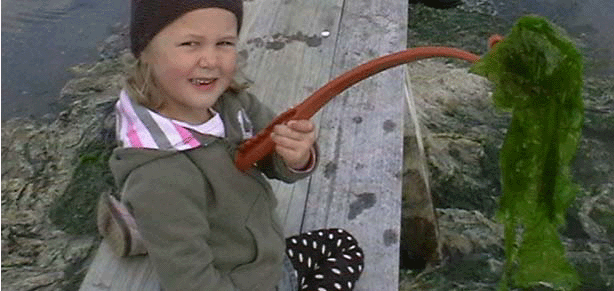
Tauranga's sea lettuce has the same lethal potential as its equivalent on a French beach that knocked out a rider and killed a horse, says Eddie Grogan, Environment BOP's group manager, water management.
Tauranga Harbour's sea lettuce isn't here in enough volume to kill a horse, but it sure smells like it.
Holidaymakers have been told to keep away from seaweed-covered beaches in northern France after warnings it could give off lethal fumes when it rots, a British newspaper reported this week.
A stretch of beach in Brittany had to be closed after a horse rider lost consciousness and a horse died as a result of the putrefying algae, The Times reported on Thursday.
Local residents have also been treated in hospital.
As the seaweed, known in France as sea lettuce, decomposes, it forms an impermeable white crust under which hydrogen sulphide accumulates.
When the crust is broken, the gas is released, which smells like rotten eggs.
It attacks the nervous system and can kill a man or an animal within minutes, Alain Menesguen, director of research at the French Institute for Sea Research and Exploitation, said.
Hydrogen sulphide gas from rotting sea lettuce is something people do need to be aware of and has been identified by Environment Bay of Plenty as a potential hazard, says Eddie.
'It's not species specific. Hydrogen sulphide can be produced from anything if you get the right conditions – anywhere where you have organic matter breaking down with no oxygen getting to it and very still weather conditions, which allow the gas to accumulate or at least remain concentrated.
'It can even be produced from a pile of grass clippings, given the right conditions, although it does tend to be more prevalent in marine and geothermal environments.
'In favourable conditions sea lettuce blooms in Tauranga Harbour can cause accumulations that produce hydrogen sulphide. However, any gas is easily dispersed by the wind.
'If you have a large accumulation of sea lettuce in very still conditions you do have to be aware of the potential for hydrogen sulphide gas being released. The rotting sea lettuce would also have an objectionable odour.”
Sea lettuce concentrations in and around Tauranga at the moment are way lower than they were in the early 1990s when there were large areas of sea lettuce accumulating, says Eddie.
But the Tauranga accumulations of sea lettuce are nothing like the quantities found in Venice Lagoon and in the Brittany beach area that was referred to, says Eddie.
'People should be aware of the potential hazard and use their common sense when near water.”
In Tauranga Harbour sea lettuce blooms tend to be caused by natural conditions, a coastal up-welling of deep sea nutrients, with human derived nutrients only playing a minor role.

1 comment
GREENMAN
Posted on 08-08-2009 12:19 | By The author of this comment has been removed.
Arrgh! Hoss and I will not be riding in the briney, we might slip, fall, or secumb to the rotten gas!
Leave a Comment
You must be logged in to make a comment.