


A life vest inspired by a free diving death at Karewa Island, 14km from Mount Maunganui, has come second-equal in an international student design award.
James McNab, an industrial design graduate from Wellington's Victoria University, designed the Revival Vest after family friend Jacob Beck-Jaffurs died after losing consciousness while spear fishing last March.
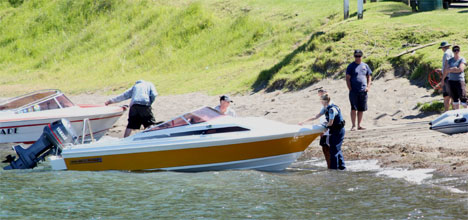
The body of Jacob Beck-Jaffurs is brought to shore at Pilot Bay in March last year.
The 24-year-old trainee doctor and his friend were free diving at a depth of about three metres when he was found dead on the seabed by his dive buddy.
CPR was administered but Jacob was pronounced dead after he was brought to shore at Pilot Bay.
James says as a medical student Jacob was very aware of the risks of diving and took safety precautions, but on the day he died he pushed himself too hard and blacked out.
Jacob was in Tauranga doing a six week internship rotation at Tauranga Hospital as part of his training when he died.
The Revival Vest James has invented uses smart fabric technology to trigger the vest to inflate based on changes in bodily signs.
It can detect changes in circumference and stretch around the chest. If a user blacks out and his or her body becomes limp, the vest is triggered to inflate and take the diver to the surface in an upright safety position ready for resuscitation.
James says conventional vests restrict movement and are too buoyant, whereas the Revival Vest is light and flexible.
The Revival Vest can be used in many water sports, including fishing, kite surfing and kayaking.
The invention was entered in a design competition run by the British-based James Dyson Foundation, set up by bag-less vacuum cleaner inventor Sir James Dyson.
Feedback is good from local and international sports vest manufacturers, says James. But he has yet to find a company or person to help commercialise the design.
First place in the competition went to a product called SafetyNet, which involved a series of rings that can be retrofitted to trawler nets providing an illuminated escape route for young, unmarketable fish.
The rings exploit escape behaviours of fish, with small and medium fish swimming up when stressed, while larger fish swim down.
Designer Dan Watson, a graduate of Britain's Royal College of Art, won £10,000 (NZ$19,500) for his idea.
The other runner-up, from the United States, designed an adjustable, robust and affordable prosthetic socket able to be used around the world.
That project and James each won £2000 (NZ$3900).

0 comments
Leave a Comment
You must be logged in to make a comment.