


A big-ticket stormwater project is under way in Whangamatā with physical works set to start this week.
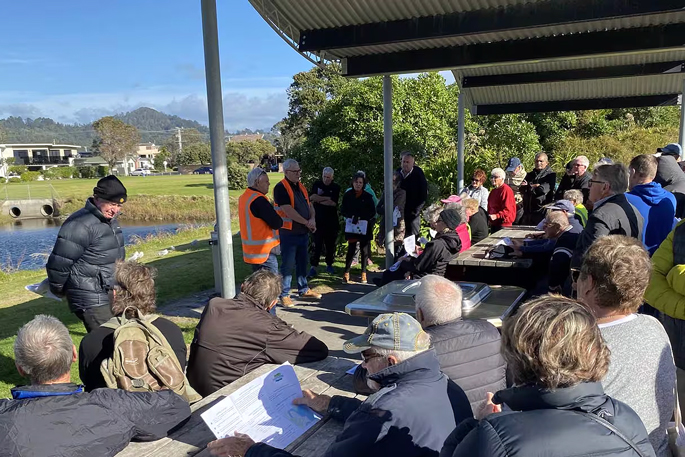
Thames-Coromandel deputy mayor and Whangamatā resident Terry Walker was joined by Thames-Coromandel District Council engineers onsite at Williamson Park on Friday where they addressed residents on the $700,000 project, which aims to improve water flow in the Williamson and Ocean roads stormwater pipe network.
Terry says a proposal to improve the town’s stormwater kicked off in 2017 following flooding and it was
presented to the Long-Term Plan (LTP) in 2018.
“Every 10 years we used to have a flood in Whangamatā, residents would wait it out to dry, then floods became more regular.”
The 2017 flood event was the catalyst for change, he says.
In 2021, $1.2 million was earmarked for a working plan and the council had recently pledged $9.2m over 10 years in the 2024-34 LTP to improve stormwater infrastructure across the town, he says.
Work will get under way this week when the pond at Williamson Park is drained and backfilled.
“This is a way to get control of water when a storm comes, we will move the water as quickly as we can.”
A couple of attendees raised concerns about the perceived lack of communication around the project.
Terry says that's not the case, as it's all in writing, contained within the LTP.
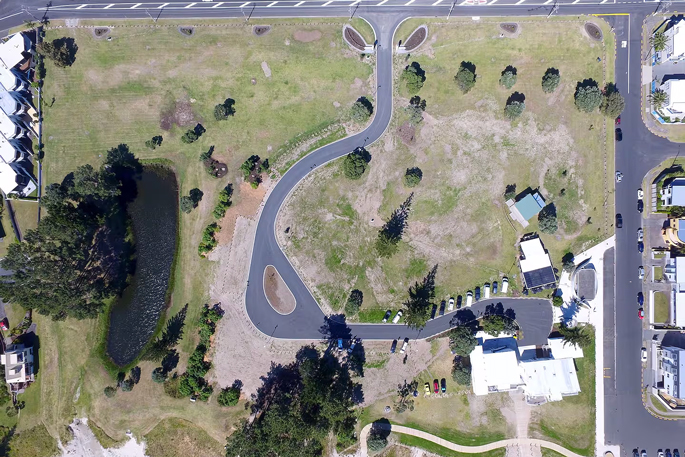 A view of Williamson Park from the air shows the pond, to the left, which will be drained and backfilled.
Whangamatā resident Kay Baker raised concerns with the Hauraki Coromandel Post last month when she said the project lacked community consultation.
A spokesperson for the council says a solution has been discussed at a recent meeting of a community engagement team which was formed to gain community input into the work.
The engagement team includes three representatives of the Whangamatā Ratepayers’ Association, two community members who are civil contractors with experience of the Williamson Park pond, a member of the Whangamatā Community Board, a councillor and the council water services manager.
Of the seven community representatives, five are supportive of the solution. The Waikato Regional Council has confirmed it supports the solution, which met its stormwater guidelines.
The objective is that the solution would be implemented in June and be completed in July.
“Thames-Coromandel District Council has not spent a lot of money; this is the first off-the-shelf project with others to follow,” says Terry.
“There will still be a lot of soakage, we are on a sand bar.”
The intention is also to improve water quality reaching Whangamatā Beach and reduce the frequency of algal bloom.
New components will include a new pipe to the beach in an effort to drain water faster, improve use of storage and reduce permanent ponding levels.
There will also be planting to absorb contaminants present in the water.
An outlet pipe at the beach end would keep the permanent water level in the wetland low while a non-return valve would be fitted into the outlet pipe to protect backflows from the sea.
Gabion baskets on the beach will be extended out to reduce the speed of water and mitigate beach erosion.
Water will flow into the wetland through sediment capture devices which would pre-treat water to reduce sediment entering the wetland.
Water will enter the wetland and flow over a rock bund to slow it down.
As water flows over alternating shallow and deep-planted areas, the plants will absorb contaminants present in the run-off.
Under low-flow conditions, water would leave the wetlands through the outlet pipe onto the beach. Under high-flow conditions, water would flow out onto the beach via an emergency spillway (the same as the existing pond).
Flow will pass over the gabion baskets, which will slow down the speed of water and reduce beach erosion.

0 comments
Leave a Comment
You must be logged in to make a comment.