


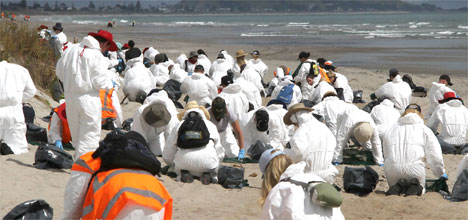
The endless hours spent by people crawling across Western Bay of Plenty beaches picking up the oil split from the grounded Rena has paid off big time, according to the preliminary scientific findings.
The handpicked removal of oil contaminated sand and manual cleaning of rocks was a unique feature of the Rena clean-up, with overseas oil spills typically using machinery to remove oil from beaches.
Volunteers work to clean the beaches following the oil spill from the Rena.
Waikato University Chair of Coastal Science Professor Chris Battershill says the manual clean-up techniques meant heavy machinery that pushes oil deep into the sand leaving toxic remnants for decades could be avoided.
Chris, who is overseeing the Rena recovery monitoring programme, compares Rena with the March 2009 Pacific Adventurer oil spill on Moreton Bay.
Battered by Cyclone Hamish the ship leaked an estimated 276 tonnes of heavy fuel oil into Moreton Bay, near Brisbane.
It is estimated the Rena spilt about 350 tonnes of heavy fuel oil into Bay of Plenty waters following its grounding on October 5 last year.
The findings from the 30,000 samples following the Rena spill released today show that while beach life was affected by the oil, which may have ongoing undetected effects, Chris says on the whole the environment appears to have bounced back.
The Moreton Bay spill is expected to continue its polluting the environment for at least 20 years as oil buried in the sand is returned to the surface by storms.
Chris and David Schiel of Canterbury University say the preliminary findings are being released now to mark the one year anniversary of the Rena's grounding, but the sampling survey is only one third complete.
Studies of intertidal rocky reefs that were fouled by oil have found up to 20 per cent mortality in mussels and other attached organisms. The areas are being monitored during coming months to determine if there is full recovery.
There is also the possibility of sub lethal effects on reproduction and population dynamics of many species. Ecotoxicological assays will be undertaken during summer.
The findings were presented to media today ahead of the public presentation tonight.
Scientists and clean-up specialists immediately began taking samples from all the coastal marine environments and the reef in the days following the ship's grounding to give them a baseline against which to measure any later environmental effects.
'It's very difficult if not impossible to identify the environmental impact if you don't know what it looks like in the first place,” says Chris.
'You need to know a starting point, and we have that.”
Chris says their initial sample gathering was impacted by the storms in the week after the Rena grounded, but they were able to draw upon a legacy of background information from annual monitoring done by the regional and city council.
The sampling surveying has continued throughout the aftermath, and also concentrated on the kaimoana species.
One of the key priorities of sampling has been to identify contamination by PAHs - polycyclic aromatic hydrocarbons. There are many forms of PAHs with the Rena's having a distinct signature.
David Schiel says by identifying Rena's signature PAH they are able to trace and identify what oil appearing on Bay beaches came from the ship.
This is done by gas chromatography.
Samples of the oil found on Papamoa beach two weeks ago have been sent away and they are currently awaiting the analysis of those samples.
David says there were elevated levels of PAHs in some marine species immediately after the oil spill, but from most samples taken so far PAHs appear to have dissipated in the last year in most areas.
'This year they are back to near background levels,” says David.
'We took thousands of samples.”
In coming months the researchers are anticipating returning to the reef itself, which they have been excluded from during salvage efforts.
As well as sampling the reef life Chris says they will have the use of a unique submersible research tool on loan to the INTERCOAST programme, established by Waikato University and Bremen University in Germany.
It will be able to survey the deeper parts of the reef inaccessible to divers, and offshore from the beaches with the intention of determining how much oil remains on the coastal seabed.
This summer there will be 15 students engaged in ongoing environmental studies as well as volunteers and iwi based projects to better understand the recovery and on-going effects.
The public presentation of the first round of environmental sampling is at the Mount Surf Club tonight at 7.30pm.
Meanwhile Green Party oceans spokesman Gareth Morgan says the Government shouldn't take signs of environmental recovery as an excuse for its inaction to make coastal shipping safer.
'Let's not forget that it has taken thousands of volunteer hours and millions of taxpayer dollars to clean up the Rena mess,” says Gareth.
'Over 2000 birds were found dead, which represents an estimated tenth of the total bird deaths from the oil spill.
'It will take more time for scientists to determine the long-term environmental effects of the Rena, but given the devastating short-term effects on the environment and economy, the Government should do everything it can to avoid Rena-like accidents in the future.
'The Government has done nothing to make container ship spills, like the Rena, less likely, and is actively increasing the risk of an oil spill by encouraging oil companies to conduct deep sea oil drilling in our waters.”

0 comments
Leave a Comment
You must be logged in to make a comment.