


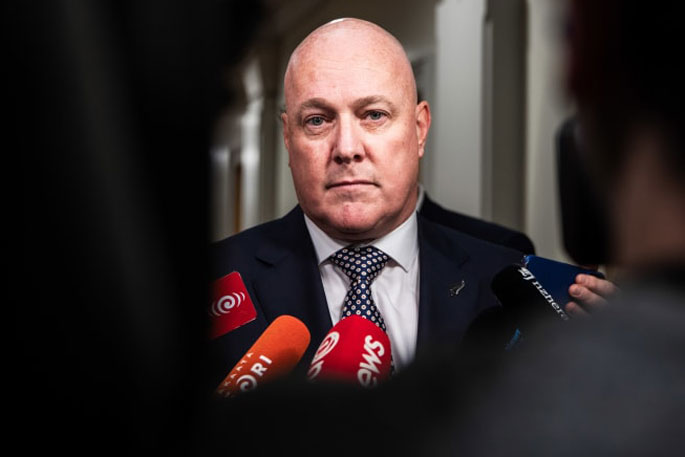
National is promising new ways of ensuring fiscal discipline, including tying department heads' pay to performance again.
In a speech to Auckland's Chamber of Commerce on Monday afternoon ahead of Thursday's Budget, leader Christopher Luxon outlined a trio of new policies aimed at transparency in government finances.
They would include:
- Policy reports: Annual reports by Treasury on the performance and results of major programmes like health, education, and social development. This will require agencies to monitor programmes and collect data to measure performance
- Taxpayer receipts, government 'report card': Taxpayers and beneficiaries would receive a yearly list of taxes paid and government payments received, with breakdowns of where the money is spent. Treasury would also produce a "report card" alongside the Budget each year, with "per-household" statistics on tax revenue, spending and debt
- Performance pay for public sector bosses: Chief executives in the public sector and their deputies would have their pay linked to achievement, bringing back a policy brought in by National but scrapped by Labour in 2018
He told reporters he expects this could all be funded within current baselines.
"I can tell you it's going to be very achievable within our baselines and it's a core function of what we expect from the public service to do, and they just stopped doing it.
"With 14,000 more public servants in Wellington since this government came to power there's plenty of resource to do it, the reality is that's a core function of Treasury is to make sure there are strong business cases for initiatives to launch and importantly, to make sure there's a really strong evaluation afterwards."
His deputy Nicola Willis says she thinks it can be done by AI.
'It's your money, and you deserve to know what it's being spent on'
As well as talking up National's already announced policies, Luxon's speech talked about a growing "unhealthy relationship" between businesses and government.
"The government is so keen to intervene and set new rules that major companies increasingly look to Wellington for direction, before developing their own investment plans.
"It's created an unhealthy dependent relationship that is depressing the spark and innovation for which Kiwis have historically been famous."
The government has "abused" taxpayers for the past six years, says Luxon.
"I am sick of taxpayers being treated like a bottomless ATM, to be raided at any time, for any reason. National will respect taxpayers and bring fiscal discipline back to Wellington."
Monitoring of major spending is something the auditor-general has been calling for, and will be brought in via an amendment to the Public Finance Act, he says.
"I won't put up with pouring more money into broken programmes that don't work - even while we need more funding for frontline services like health and education - but to get that right, we need the right information."
The taxpayers' receipt scheme will be delivered when tax returns are finalised, he says.
"Too much financial reporting is impenetrable - unless you've worked in the machine in Wellington, or you've trained for years in accounting or economics, it's impossible to work out just how much money the government spends, and where it all goes.
"It is your money - and you deserve to know what it is being spent on."
He says the public sector has been "hollowed out" since performance pay has been removed. Under National, it would be brought back in and applied to deputies as well as chief executives.
"A culture of high performance and accountability needs to be created in Wellington - and that starts with rewarding people based on outcomes."
Luxon paints a grim picture of the country's finances - homing in on the current account deficit.
"The country recently recorded its largest current account deficit on record at almost nine per cent of GDP, meaning as a nation we're spending far more than we earn - and we're world beaters at it, we have the largest current account deficit in the OECD.
He compares this to the situation during the global financial crisis.
"It's one thing to be spending heavily and operating deficits as you revive an economy with high unemployment and stagnant inflation - as the automatic stabilisers of welfare spending rises and tax receipts fall, but that hasn't been the scenario this time. Unemployment is half what it was in the aftermath of the GFC, and inflation is just driving the tax take ever upwards. Responsible governments cool fiscal pressures at the top of the economic cycle - but we've seen exactly the opposite here."
Despite Prime Minister Chris Hipkins and Finance Minister Grant Robertson's claims otherwise, he says there's a real chance Labour will deliver something on tax - but it will be "too little, too late, and offered only in an effort ... to secure a third term".
'Maybe it's time for them to go back to the drawing board'
Hipkins, speaking to media after the weekly Cabinet meeting, says the policy shows National's priorities are in the wrong place.
Much of the information is publicly available, and National os effectively proposing sending out "spin-doctory type letters" to the majority of New Zealanders to explain where their tax dollars are going.
"This is their opportunity to set out what they would do differently in government. If this is the best they can come up with I think maybe it's time for them to go back to the drawing board.
"Every year when the Budget is released, we release a summary of where taxpayer money goes, what New Zealanders are buying for their taxes.
"It's a bit like pledging to bring back the bank statement, really. Ultimately anyone can look up on their myIR website, any day, how much tax they have paid. That information's publicly available."
He says he thinks it would be an "incredible waste of money".
"It's certainly not going to be a cost-free exercise. Someone would have to pay for those letters to be written, and for them to be sent out. Ultimately that's going to involve employing people to do that."
Hipkins was dismissive of the performance metrics policy, too.
"There's a very novel idea which is that you could specify performance measures for all of the money that government spends in each year's Budget then each year you could report back on whether those performance measures have been met through that spending. We do that every year, it's called the Budget documentation.
"It comes down to what performance measures you specify ... if there's dissatisfaction with the performance measures well, the National Party could come up with some different performance measures and say this is what we're going to measure instead. They haven't done that."
He says reviews of spending effectiveness did typically get performed on new spend, but in many cases that's done by the relevant department rather than the Treasury.
Hipkins refused to be drawn on whether the Budget - due out on Thursday - would include any change to tax or any major surprises.
"I think what New Zealanders will see in the Budget on Thursday is that it's a Budget that speaks to the times that we are in at the moment," he said.
"I'm very proud of it."

2 comments
The Country
Posted on 17-05-2023 09:30 | By Merlin
The Country does not run like Corporation making profit for the stakeholders. It is about providing services and doing things for the benefit of all New Zealanders.I would like to hear more on this than this stuff.
Agree with Merlin
Posted on 17-05-2023 22:31 | By This Guy
CEO's tend to have psychopathic traits because they're the people who can "make the hard decisions" - Like firing thousands of people to save the company some money, then forcing the people who are left to do all the extra work without a raise. Oh and then they get a multi-million dollar bonus for all the money they saved... Not the kind of person you'd ever want running a country
Leave a Comment
You must be logged in to make a comment.