


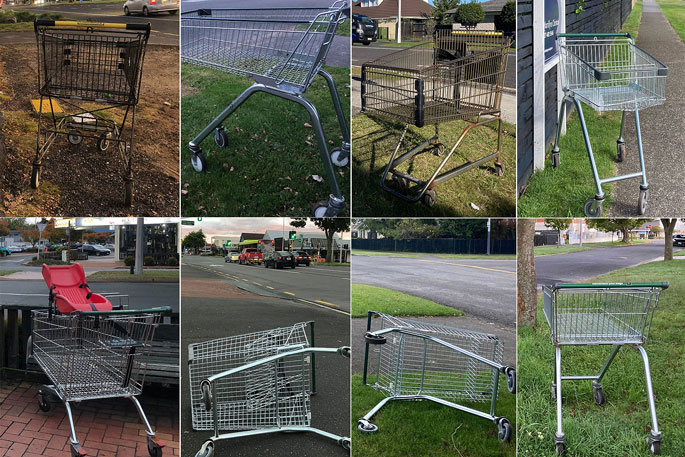
Ratepayers are paying $5000 a month for hundreds of abandoned trolleys to be collected from Rotorua's streets - and the council wants business owners to shoulder some of the cost.
The chairman of the city's ratepayers association blames some members of the homeless community for the problem and wants Kāinga Ora to implement 'trolley hunts”.
However, Kāinga Ora says anyone could be to blame and trolley hunts are not a priority.
Rotorua Lakes Council community wellbeing deputy chief executive Anaru Pewhairangi told Local Democracy Reporting the council is responsible for recovering abandoned trolleys because they are classified as illegal dumping.
Council contractors pick up the trolleys as part of the city cleaning schedule.
'Unfortunately that comes at a cost.”
About 260 trolleys are removed from the inner city each month, costing ratepayers about $5000 per month.
'Trolleys on roadsides are obviously untidy and a hazard and that impacts on how both locals and visitors view and feel about a place.”
Abandoned trolleys also affect perceptions of safety and can harm the environment, he says.
'We will continue to discuss the issue with businesses where trolleys are taken from to try to get them to share some of the burden.”
Pewhairangi says, anecdotally, streets near the Rotorua Central shopping centre and Fenton St have had the most abandoned trolleys over the past couple of years.
Rotorua District Residents and Ratepayers Association chairman Reynold Macpherson says ratepayers are annoyed they are paying for the collection. The association wants the businesses that own the trolleys to reimburse the council for their collection.
'Ratepayers do not have bottomless pockets. Many are struggling.”
Macpherson believes that while it's unfair in some cases, abandoned trolleys are 'strongly associated” with some of the city's homeless people.
He says, in his view, Kāinga Ora needs to enforce stricter tenancy management or needs to organise trolley hunts.
Macpherson believes the council should impound the trolleys until owners pay the collection bill.
Kāinga Ora acting Bay of Plenty regional director Karen Hema suggests it's people from 'all walks of life” who leave shopping trolleys across the city.
Its focus is on rapidly building new public housing, she says, placing whānau into these homes, and supporting customers to live well, as part of the wider community.
'Trolley hunts are most certainly not our focus.”
There are numerous supermarkets in Rotorua's inner city. Local Democracy Reporting contacted Countdown and Foodstuffs. The latter owns the Pak'n'Save and New World chains.
A Countdown spokesperson says it spends $1.5 million a year nationally collecting abandoned trolleys but could not say how much money is invested into trolley collection services in Rotorua.
This also covers the cost of printing messaging on its trolley handles detailing how to report missing trolleys.
'We monitor through customer reporting, and our customer care tracking indicates that Rotorua does not have a higher rate of customer feedback or trolley pick-up requests than other parts of the country.”
Countdown understands abandoned trolleys can be a nuisance and that's why it invests in collection services to lessen the impact on the community.
'We want to keep our local communities tidy and trolley free and ensure that we have enough trolleys available for our customers in our stores.”
Countdown asks people to contact its customer care team to report abandoned trolleys, or to talk to its in-store customer service team.
Foodstuffs spokeswoman Emma Wooster says it's disappointing that trolleys and baskets are being stolen or dumped.
She says most stores have a dedicated team member responsible for looking after trolleys, but sometimes they are taken.
'On these occasions, we ask all members of the public to report a misplaced, or stolen trolley to their local police, or store, so arrangements can be made to retrieve it.”
- Public Interest Journalism funded through NZ on Air.


5 comments
Hmmm.... our council lacks common sense
Posted on 04-04-2023 12:21 | By Omni
These trollies are owned by their respective companies, be it a supermarket or other outlet that provides them for use by their customers. Surely trolly owners want these back, as they are expensive and valuable to their business requirements, in which case A) either companies should have the ability to promptly collect them at their own expense or B) They should pay council to have them released back to them. If trolly owners had a payment system with say a $1 fee to release one, then you got $1 back for delivering back to the trolly storage location there would be none of these floating around the community, and if their were some out there kids/people would be happily pushing them back to the correct location for the payout - where is basic common sense these days?
Shopping Trolleys
Posted on 04-04-2023 12:35 | By Sycamore2
In British Columbia, Canada 50 years ago, one supermarket blocked customers from taking trolleys out the door. When you finished getting your groceries, and your trolley was loaded, you were given a numbered ticket corresponding with the number on the trolley. The cars lined up where trolleys were waiting and staffe put your groceries in your boot upon matching your ticket with the trolley number. No tipping for this service allowed. Worked well, no reason it wouldn't worked here, but always excuses why things won't work here, including a large proportion of the population.
Fire Tolley
Posted on 04-04-2023 12:57 | By an_alias
Thanks should pay for it, problem solved !
Shopping Cart Theory
Posted on 04-04-2023 14:55 | By This Guy
"The shopping cart is the ultimate litmus test for whether a person is capable of self-governing, the post states. To return the shopping cart is an easy, convenient task and one which we all recognise as the correct, appropriate thing to do. To return the shopping cart is objectively right. There are no situations other than dire emergencies in which a person is not able to return their cart. Simultaneously, it is not illegal to abandon your shopping cart. Therefore the shopping cart presents itself as the apex example of whether a person will do what is right without being forced to do it."
An expensive problem
Posted on 04-04-2023 14:56 | By Kancho
Trolleys are very expensive . Terrible we have people in our society that don't care or too lazy about anything it seems. Not unknown elsewhere. When visiting the UK the trolleys have a locked rack system that requires a one pound coin to release on return into the rack it gives back the fee. Cost about to set up but I guess it would pay for its self fairly quickly
Leave a Comment
You must be logged in to make a comment.