


The east coast of the Coromandel remains largely cut off from the rest of the country, with access in and out severely impacted by landslides.
A fix for State Highway 25A will not be in place before Christmas, but engineers are drawing closer to a decision on the best path forward.
On Monday, media were allowed a rare glimpse into the cavernous divide that effectively splits the peninsula in two.
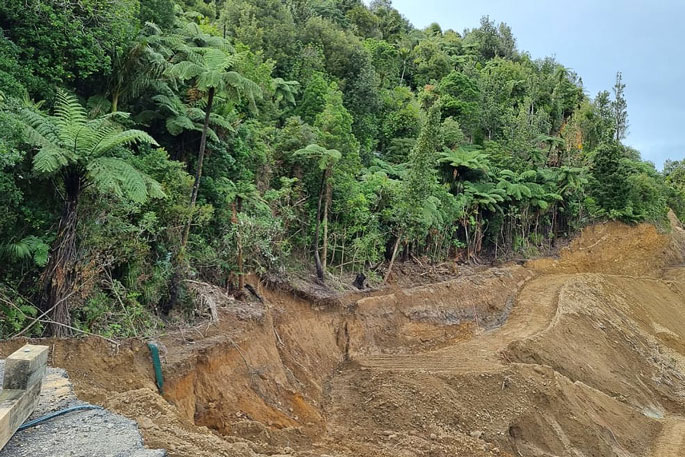
A 140m stretch of road is missing from SH25A, which has been closed since cracks appeared on January 27 in the wake of ex-Cyclone Hale.
The site now resembles a quarry, with much of the initial debris cleared from the slip.
But site managers reminded reporters of the dangers that lingered under the surface, instructing them to stick to the paths carved out unless they wanted to sink waist-deep into a quicksand-like substance.
A decision on what would become of this route may yet take another two months.
Waka Kotahi regional manager of infrastructure delivery Jo Wilton says there are three options on the table.
"Reinstate the road using some form of retaining, a bridge option, and then a bypass, which is where we'd look at going around the slip, up the hill."
Jo says engineers are not currently leaning towards any one of these options, with that choice reliant on the outcome of their geotechnical investigations.
She will also not categorically rule out the remote fourth possibility of a tunnel through the mountains.
However, the cost of this would likely be a prohibitive factor.
"We can't say that tunnelling's completely off the table, but that is quite an expensive option.
"You also need to really look at the geotech to see what you're hitting when you're tunnelling, because you can't actually see when you're tunnelling - you're tunnelling blind."
After a preferred option for the road is selected in May, further design work will need to take place before construction can begin.
It means the start date could fall into the wetter winter months - less than desirable for a project on such unstable ground.
"A lot of the material we're finding is kind of clay stuff," says Jo.
"When water hits that it goes very much like plasticine and gets very sticky.
"That is quite challenging to work with in winter, so that's a consideration, whereas there are other methods - say building structures - that can progress in winter, albeit a little bit slowly depending on the weather, because obviously if we get torrential rain, it becomes unsafe to work."
Jo says any fix will take nine to 12 months to implement, meaning residents or visitors looking for a solution by Christmas will be disappointed.
The project's lead geotech engineer, Nathan McKenzie of Beca, says work has been delayed while material is moved to stabilise the site for drill rigs.
His team is now about two-thirds of the way through their investigations.
They have drilled 10 boreholes and are currently working on the 11th and 12th, aiming to find rocks or soil stable enough to support the weight of a new structure without the risk of further slips.
"We're expecting the geotech investigations to be substantially complete this week, and from then on we'll be looking to start assessing and basically refining options using that information," says Nathan.
He says drilling has uncovered a mixture of material in the ground, from weak slip debris containing a lot of water to areas that were "marginally stable".
"The residual soils, they are quite variable: some are sandy, some are clay-y, and then the rock itself is quite variable.
"We're finding in some areas we're hitting quite competent rock quite quickly, in other areas it's very deeply weathered."
Using the data collected, the team will build a full model of the site, which Nathan says should provide a clearer picture of what's needed.
After that, the criteria for a decision will become relatively simple.
"We are looking at cost, we're looking at something that has to work, something that has to meet design standards, and we're also looking at something that can be done fast."
Speed is an important factor for many residents and businesses cut off by the slip and fearing the loss of another summer's trade.
Second slip
Meanwhile, another slip on the eastern side of the Coromandel - between Whangamatā and Tairua - is also a cause for concern.
A large chunk taken out of the road has seen this section of State Highway 25 reduced to a single lane open to light vehicles only.
With the rebuild of this road only due to start in April, holidaymakers looking for a relaxing time at the peninsula's beaches this Easter may face a testing drive to get there.

0 comments
Leave a Comment
You must be logged in to make a comment.