


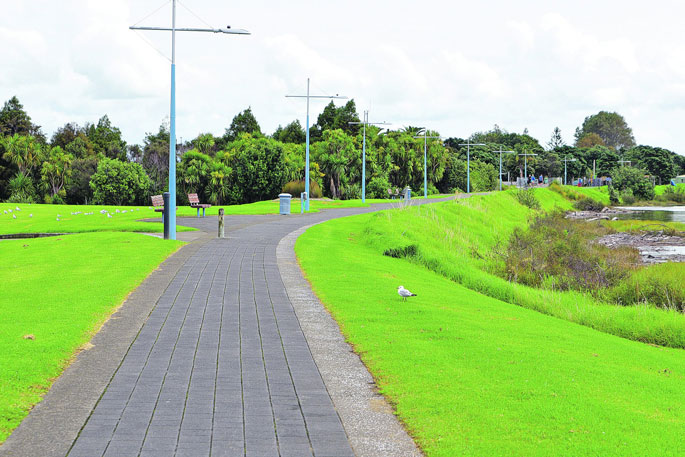
Whakatāne cannot rely on its current stopbanks to protect it in the future, the Bay of Plenty Regional Council heard at a meeting last week.
Councillors were updated on Project Future Proof - the regional council's plan to raise floodwalls and stopbanks in the Whakatāne town centre by 800mm – by senior environmental engineer Mark Townsend.
Chairman Doug Leeder introduced the report, saying ex-Cyclone Debbie, in 2017, was best remembered for causing the Edgecumbe floods but what many people didn't realise was that Whakatāne River had also come close to overtopping its banks during that storm.
'It wasn't the first priority after the 2017 event but now it's the next one we need to get on to.”
Mr Townsend talked about his experience watching Whakatāne River rise during the 2017 storm and how close the town was to having to evacuate at 3am.
'The only reason it didn't go over the top was because the sea was, basically, dead flat. At 3am I was on the phone to Civil Defence and we were preparing to evacuate Whakatāne, but we knew that the tide was going down. They said, ‘you've got half an hour'.”
Luckily for everyone tucked up in bed in Whakatāne at that time, within that half an hour the water had begun to recede.
Mr Townsend said though strengthening Whakatāne's flood defences had been 'in the train” (sic) before that time, the experience had reinforced the importance of it and helped accelerate the work the council wanted to do.
'It was an example of how close we were to going over the top.”
Remedial work is also happening on the Riverside Drive stopbanks, in a project named Save Our Stopbanks.
Project Future Proof worked in with this and targeted the stopbanks from the McAlister Street pump station to the boat ramp at The Heads.
As well as a lack of height, there were also known areas of uncontrolled seepage in the Kakahoroa Drive, Quay Street and Whakatāne Boat Ramp areas.
Planned work included installation of sheet piles to control seepage, seepage trenches to collect any water that gets past the piles, raising the stopbank and a floodwall.
A programme of work was budgeted in this year's annual plan to take place along the stopbank from the Whakatāne Yacht Club to the eastern end of Quay Street. This was planned to begin in the first half of this year.
However, to work in with Whakatāne District Council's Te Ara Hou town revitalisation plan, the timing of this work has been adjusted.
The stopbank along Kakahoroa Drive, between the McAlister Street pump station and the Whakatāne i-SITE will now be the focus for this year.
'The district council have some proposals [along Quay Street] to raise the whole stopbank area and make a feature of it. It's going to take them some time to work their way through it, but we want to be able to give them some room. The two proposals are compatible,” he said.
The regional council's plans for this year include increasing the height of the stopbank between McAlister Street and the Whakatāne Yacht Club and increasing the height of the flood wall between the yacht club and the information centre.
The height of the concrete slab wall, which will sit on the town side of the Warren Cole Walkway, would differ from 600mm at the yacht club end to 1.7 metres at its highest point near the information centre. This was due to inconsistency in the height of the current stopbank.
Mr Townsend said his team had been working with Ngāti Awa to put some rendering on that wall, etched into the concrete panels on the river side of the wall.
'Ngati Awa are coming up with three different designs to try and break up that stark concrete effect.”
The new wall would provide enough capacity for the regional council to meet its level of service in protecting the Whakatāne town centre until 2040.
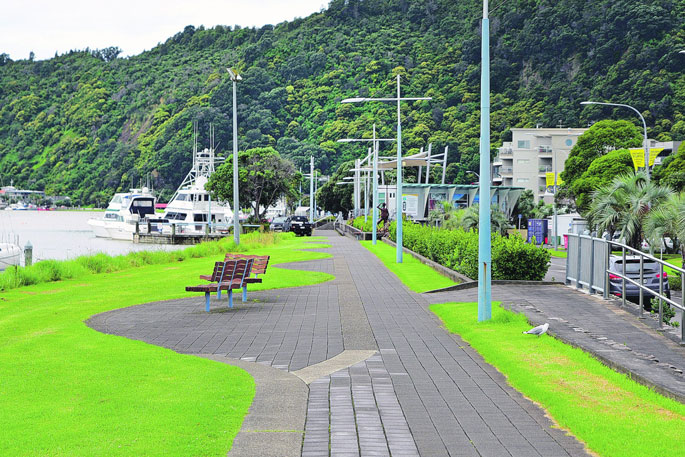 The Bay of Plenty Regional Council plans to place a concrete flood wall between the Warren Cole Walkway and the hedge on Kakahoroa Drive sometime this year.
Mr Townsend showed councillors a graph showing stopbank height required to keep pace with sea level rise projected over the next 100 years. T
he graph showed that, even with the completion of the work currently planned, a further decision would be required by 2040 to either raise the stopbanks again, carry out work in the upper catchments to slow water flow, or reduce level of service and enter a phase of managed retreat.
He said it was very likely that raising of the stopbanks upstream of the McAlister Street pump station would also need to be done in another 10 years, despite progress being made on Project SOS.
Ōkurei Māori Constituency councillor Te Taru White asked what retreat from Whakatāne might look like.
'As engineers, there must come a time, given the nature of the events, when you throw your hands up and yell retreat."
Mr Townsend said due to the flatness of Whakatāne, managed retreat would have to be abrupt.
'I don't want to scare people,” he said.
'Managed retreat usually means to retreat from the worst affected areas slowly and progressively move further and further back. Whakatāne is so flat behind the stopbanks that it might not be progressive, it might be a once off. But there's obviously a lot of rhetoric going to happen first.”
Mr Townsend said he had talked to councillors three years ago about options to slow water flow upstream of Whakatāne, around Waimana, that would lessen the need for raising walls.
This would include a series of bunds to contain spill from the river. At that time they had wanted to engage with Ngāi Tūhoe, Ngāti Awa and Whakatāne District Council about trying to reduce the flow that comes down the river to Whakatāne and reduce the need to raise the stopbanks.
'There hasn't been much progress at all. We've finally got around the table with Tūhoe, but we've only been able to talk about maintenance, we haven't been able to talk about these kinds of projects. So that's three years that we just haven't been able to progress. We could be sitting here in 10 year's time having the same conversation,” he told the councillors.
He said the current work would buy the council more time to get that upper catchment work going.
Tauranga general constituency councillor Kat MacMillan commented that it was important to get the balance right with consultation so people weren't afraid, but they were prepared to accept the new reality.
She had felt there was 'quite a lot of resistance” from Whakatāne district councillors about 'the vista being impaired”.
'I think it's a really delicate situation with not scaring the horses in terms of ‘this is the reality of climate change, sea levels rising, extreme events', but having some sense of ‘we have to do this'.”
The regional council has engaged with Whakatāne District Council staff along with Te Rūnanga o Ngāti Awa. It plans to update Whakatāne's new councillors soon and also seek written support from Ngāti Awa.
A programme of public engagement will follow this, including open days where the public will have the chance to share feedback. Consent preparation is already underway for the Kakahoroa west stopbank raising works and the council hopes to begin physical works in March.
-Public Interest Journalism funded through NZ On Air.


1 comment
river needs dredgeing
Posted on 16-02-2023 11:09 | By Gramps0497
dredge the river botom as silt just brings the base level higher the higer the banks the higher the base old enginer
Leave a Comment
You must be logged in to make a comment.