


Tauranga bakers are pleased with the Government's decision to make the fortification of bread with folic acid voluntary.
Food Safety Minister Kate Wilkinson announced her decision on Thursday following a stream of public submissions opposing compulsory fortification.
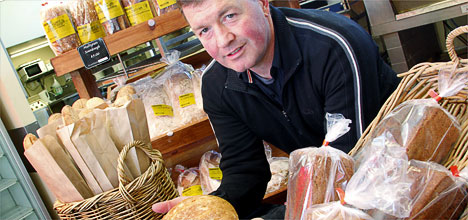
Flaveur Breads in Mount Maunganui owner Nick Parker.
The Government proposal, if it went ahead, would have made addition of folic acid in most bread compulsory in a bid to reduce the number of newborn babies with growth conditions such as spinabifida.
An eight week process by the Ministry for Primary Industries resulted in 134 public submissions – 88 supporting voluntary instead of mandatory fortification.
Blomquist Bakery in Greerton owner Sue Blomquist says she is happy with the decision.
'I think it is good news for us.”
Sue says as long as she is free to offer their customers a choice she is happy.
'From what I understood the artisan loaves were still going to be folic acid free.
'We would have been happy either way as long as we had the choice to still keep the artisan loaves folic acid free.”
Flaveur Breads in Mount Maunganui owner Nick Parker was strongly against the mandatory proposal saying it was 'completely unnecessary”.
'Our best bread has flour, water and salt. Why would you need to do anything different other than for commercial reasoning?”
Kate says her decision was made based on public opinion.
'In making my decision in favour of voluntary fortification, I read all the submissions and the clear message is that people want choice.”
This is the second time the government has shelved a proposal to make fortification mandatory, after a public outcry in 2008 from the Bakers Association and the Food and Grocery Council saying the science was a "mass medication experiment".
Kate says the current voluntary fortification has played a part in reducing women's red blood folate levels in recent years.
Between 2008 and 2011 the level of women with blood folate levels that put them at risk of having a neural tube defect affected pregnancy has nearly halved.
'Folic acid plays an important role in reducing NTDs in babies, but fortification of bread is only one part of a wider package of initiatives,” says Kate.
Other initiatives in place include the existing voluntary fortification of a range of other foods and Ministry of Health initiatives such as providing educational information and subsidised folic acid tablets available on prescription.
MPI will continue to work with the bread industry to achieve a fortification rate of up to 50 per cent of packaged bread and assist them with developing a voluntary code of practice to meet the requirements in the standard.
The ministries will monitor the effectiveness of the standard with any new data helping inform decisions on how to get the best result for New Zealand women.
Bakeries using folic acid receive annual visits from auditors currently and these visits will include checks on how they are fortifying to meet the New Zealand Food Standard 2012.
This permits voluntary fortification of bread with a maximum permissible level of 250micrograms folic acid per 100grams.

1 comment
LET THE CHEMICAL FLOW BEGIN!
Posted on 31-08-2012 15:45 | By PLONKER
At least tehre is a choice about it, so all we now need is better labeling so as consumers will easily be able to see all teh additives int ehfood before eating them.
Leave a Comment
You must be logged in to make a comment.