


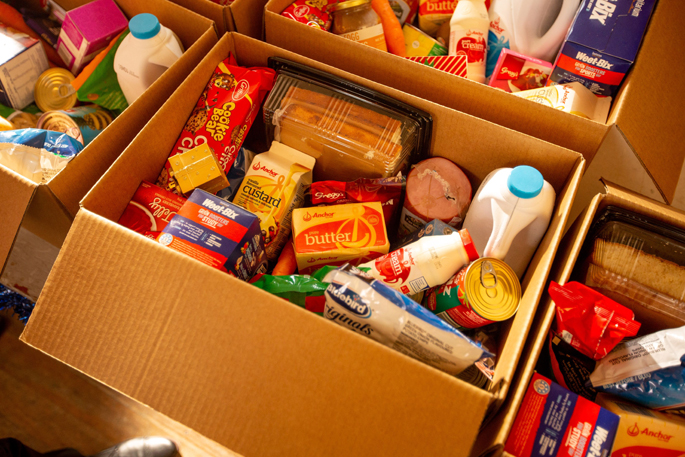
Mother-of-three Anahera and her husband are switching to diet shakes to help cut their food bill, because, she says, they do not qualify for enough government support.
Her husband works 40 or 50 hours a week as a labourer, and earns about $1000 a week after tax.
A couple with children must earn no more than $969 a week between them, before tax, to qualify for any Jobseeker Support.
Anahera, who does not want to be identified, says she has always had mental health issues and is currently waiting for ACC to approve more counselling.
"But my mental health issues make it extremely hard to function 'normally' daily, as well as having psoriasis, arthritis and having pain in most joints daily.
"All we are entitled to weekly is the accommodation supplement. Our rent is $700 a week with $15 for water on top as we can't afford to not be in credit as we can't afford extra bills. According to Work and Income, my husband earns too much for me to be getting any kind of sickness benefit or any benefit."
She says the welfare system has not kept up with the increasing cost of living.
"Everything apart from our income is rising. We pick and choose between food and petrol. We have just started our two-shakes-a-day diet to lose weight and try and make groceries cheaper. As long as our kids have food, we are OK, but it's still tough."
She says she's meant to be starting a new job, but she can't afford to take a day off if one of the kids is sick, and daycare fees make it hard to work.
Another woman, Sarah, says she has been surprised to find that her boyfriend's income means she can't get help. She has just finished post-graduate study and is looking for work at the time. She and her partner live with flatmates.
"I desperately needed money to make sure I could still pay the bills.
"The part that upset me the most was that they hinted that if I were to break up with my boyfriend I could come back in the next day and access more funds. We hadn't been going out that long, not even a year - the whole thing felt sordid."
She says she has thought of herself as financially independent from her partner at that stage.
"It's hard to know where to draw the line, though. Is it after you've been with a partner for a certain amount of time? Do there need to be kids involved? I think it's potentially much harder on women, who generally earn less than men."
It is something that Child Poverty Action Group spokesperson associate professor Susan St John has been worried about for some time.
She says it's "painfully clear" that the welfare system of benefits is no longer fit for purpose.
"The relationship basis of welfare payments is in desperate need of modernisation," she said when she gave the Sir Owen Woodhouse Memorial Lecture in 2019.
"Many do not get benefits if their partner is earning and the couple rate of benefit is miserably low. Marital status as determined by Work and Income penalises sole parents who try to re-partner."
St John says the issue has become more apparent as people lost their jobs during the pandemic.
"Instead of fixing the welfare system, we get social insurance," she says.
The government has proposed an income insurance scheme that would pay out 80 per cent of a person's normal salary for up to six months if they were to lose their job.
"That's not going to make anyone who is currently disadvantaged any better off at all," St John says.
"It will only apply in future as people get an entitlement under the scheme. Men in high-paid jobs will get the most."
She says expecting couples to rely on each other is an outdated approach.
"That couply kind of relationship where everything is shared - modern relationships are not conforming to that."
If a relationship test is used, it should be whether a couple will be captured by relationship property rules, she says. This applies to people who are married or in a civil union, or who have been living together for three years.
"The tax system is based on the individual, as is ACC and NZ Super but yet with the welfare system we're totally bound to this idea that you've got to look after each other and your family is the one you turn to. There are lots of things like that build into the system and we are quite blind to seeing the biases ... it's 2022 but we are still not really talking about 21st century family arrangements."
The Ministry of Social Development's acting general manager for welfare system and income support Polly Vowles says it's a long-standing element of the system that the family is the unit of entitlement for support.
"The family is defined as adults - either single or in a couple - and dependent children. This unit is used because it is generally accepted that families are financially interdependent - they will share resources to support each other.
"Financial support in the welfare system is targeted to those most in need. Because of that, it is reasonable to take into account the resources of the family to assess a person's need for financial support from the state.
"Household income is different to family income - households may contain multiple families, and these are generally not taken into account for financial support. If all welfare financial support were individualised this would result in many payments going to higher-income families and this would increase the overall cost of the welfare system significantly. The long-term welfare overhaul work programme will consider whether the unit of entitlement in the welfare system is still fit-for-purpose."

2 comments
It’s bloody tough for some
Posted on 24-10-2022 20:06 | By Johnney
The first couples rent is a real concern. This is a result of anti landlords stance by the government. No other business attracts tax on a gross turnover instead of net profit. The second example Sarah could walk into an employment agency tomorrow and get a job. Just need to pass a drugs test. I know it’s not easy but this isn’t the only generation that has endured hardship.
Is it me?
Posted on 27-10-2022 17:43 | By morepork
"...expecting couples to rely on each other is an outdated approach." Funny, I thought that was part of the underlying definition of "couple". Guess I'm old-fashioned. So now we expect the community to support us and our sex partner with enough to live on. Why stop there? Obviously our friends could use a few bob too... perhaps a stipend for all our friends on Facebook? At least its not "old-fashioned"... "That couply kind of relationship where everything is shared - modern relationships are not conforming to that." Fair enough, but don't then expect the people who are not asking for anything and live as couples, to support you and your "independent" friend.
Leave a Comment
You must be logged in to make a comment.