


The residential property market 'correction” appears to be picking up pace in Tauranga as winter draws to a close.
QV's latest rolling three-month average shows home values declined by an average of 7.8 per cent in the three months to the end of August, up from the 4.9 per cent rate of negative quarterly home value growth reported last month.
The average home value in Tauranga is now $1,099,342, which is 6.3 per cent lower than it was at the start of 2022 and just 2.4 per cent higher than the same time last year.
'Many prospective buyers appear to still be playing the waiting game – holding off making property purchases unless they find a property that is high in desirability or appears to be good value for money,” says QV property consultant Derek Turnwald.
'Demand for housing of all values has declined and is now generally subdued in comparison to what we witnessed in 2020 and 2021. Listing numbers have increased and listing periods are extending as supply increases. Open home and auction attendance is also very weak at present, with many open homes only getting around two to four visitors.”
'Vendors are now realising that the high prices attainable in 2021 are no longer a reality and that to ensure a sale in the current market they must lower their expectations, in some cases quite considerably – especially if the property has maintenance or non-compliance issues.”
Nationally, the QV House Price Index for August shows the housing market continues to cool as winter draws to a close.
Tight credit conditions and rising interest rates means fewer buyers are competing for an oversupply of stock.
This continues to put downward pressure on prices as we head into spring.
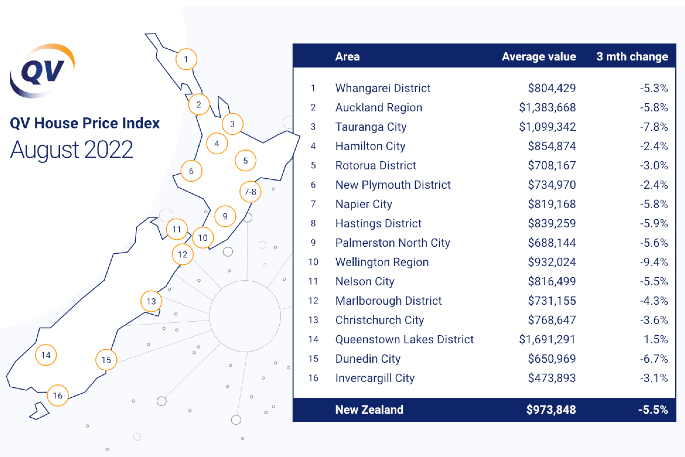
Image: Supplied.
The average home decreased in value by 5.5 per cent nationally over the past three-month period to the end of August, weakening further from the 4.9 per cent decrease in quarterly value change QV saw in July, with the national average value now sitting at $973,848.
This represents an average annual increase of just 1.1 per cent, down from 4 per cent annual growth last month.
Wellington and Tauranga are showing the largest three-month value reductions of the main urban areas with falls of 9.4 per cent and 7.8 per cent respectively.
Dunedin is not very far behind with a 6.7 per cent reduction in average home value this quarter.
In the Auckland region, the average value now sits at $1,383,668, falling 5.9 per cent over the last three-month period, with annual growth also dropping to 1.1 per cent, down from the 4.3 per cent we reported in July.
'The residential market is desperate for some oxygen with a dwindling pool of buyers spoilt for choice with an oversupply of listings. There's no immediate sign of things getting any better with interest rates likely to rise further and business confidence starting to wane,” says QV General Manager David Nagel.
'We're starting to see some pretty significant value reductions now, especially in the main urban areas where value growth was previously so strong. Market gains from August 2021 have largely been eroded from the falls in the first seven months of 2022.”
Value levels peaked nationally in early 2022, with the Wellington region hit the hardest since then, with a 14.7 per cent reduction in values since January.
Auckland has also been hit hard with values falling 10.2 per cent since peak.
Manawatu and Hawke's Bay regions have both come back 9.2 per cent since January, with all these locations having experienced exceptionally strong growth throughout the 2020-2021 cycle.
'There are mixed views on the extent of further interest rate rises, as well as how these will impact house prices over the next 12 months. Some economists are suggesting we're close to the peak of mortgage interest rates, while other commentators are predicting house prices may fall a further 25 per cent over the next 12 months.
'With borders now open, I think we'll likely see a few more people entering the property market, either as buyers or renters. However, we're also losing plenty of people heading offshore. The residential market performs much better when net migration is positive, and that time might not be too many months away.
'It looks as though it's going to get tougher before it gets any easier for sellers. First-home buyers will continue to struggle for finance with tight credit conditions and affordability constraints. Plus there's still plenty of new homes in the pipeline, which will add further to oversupply, putting further downward pressure on prices.”

0 comments
Leave a Comment
You must be logged in to make a comment.