


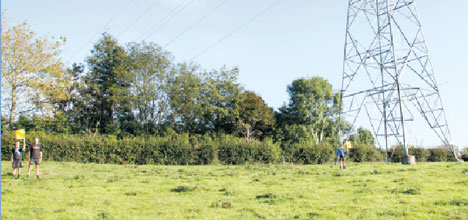
An independent commissioner is yet to release his findings on the controversial issue of whether or not transmission line buffer zones should become part of the Western Bay of Plenty District Council District Plan.
Council's manager for resource management Phillip Martelli says the commissioner has requested further information from council and his findings are expected soon.
Meanwhile Whangarei District Council is also considering including buffer zones in its plan, which Federated Farmers is calling a `land grab' and a restriction of land use.
Under the Government's National Policy Statement on Electricity Transmission, councils are required to ensure that `an appropriate buffer corridor be identified on the district plan and the buffer area put in place to protect the transmission lines from ‘sensitive activities'.
Bay of Plenty Federated Farmers took the lead early this year objecting to the inclusion of buffer zones in what is largely regarded as a test case when the Western Bay council became among the first to consider issue.
Among the most vocal opponents in the Bay has been Steve Bailey, a Te Puke farmer and member of Bay of Plenty Federated Farmers executive.
Steve says while Transpower did make some concession during pre-hearing meetings and reduced the size of the buffer zones from 64 metres to 12 metres either side of the lines, he still believes the zones should not be included in the district plan.
Steve says nationally Transpower has compensated just eight per cent of property owners over whose land their transition lines pass.
'Nationally 26,000 ha of land have some restrictions placed over it because it provides the base for the national grind to pass over.”
Steve believes adequate protection for the lines already exists under the Code of Practice for Electrical Safety Distances and Transpower should not be using council and the Resource Management Act to address its concerns regarding safety and protection of the lines.
'Farmers are electricity users too. Our businesses rely on the supply of electricity so we are not going to do anything to stop that, but we do feel farmers and landowners need to be recognised as the ‘hosts' for the foundation of Transit's asset, the transmission lines, which are on their land.”
Transpower chief executive Patrick Strange has written an open letter to farmers, in the form of a full page advertisement in Rural News called `The facts about transmission line buffer corridors'.
'I am concerned that the information in the public arena around transmission line buffer corridors has been confusing and misleading.”
'We are supportive of development around transmission lines as long as it is planned appropriately– incompatible development limits our ability to use and maintain existing lines, (ultimately resulting in the need to build new lines) and this comes at a cost to all electricity users.”
Patrick says buffer corridors address that issue and ensure activities, which may be incompatible are subject to controls.
'Buffer corridors do not provide Transpower with any new rights.”
Patrick says he is not supportive of any more restrictions around transmission lines than absolutely necessary.
'Yes we do want to protect the national infrastructure and the safety of those working on, and living around our assets. But no, we don't want landowners' farming operations and agricultural activity to be unnecessarily restricted by the introduction of buffer corridors.”
Transpower's concerns are around new buildings, structures, substantial extension to existing buildings and major earthworks in an area 12 metres either side of transmission lines called a `red zone'.
'We are suggesting that these types of activities require a resource consent.
Almost all farming activity, cropping, harvesting, grazing, ploughing, tracks will not be impacted nor will existing buildings in the 12 metre zone.”
The proposal to councils is that a `green zone' of a further 20metres either side of the 12metre red zone be established in which development activity would not require resource consent as long as it complied with the New Zealand Electricity Code of Practice for Electrical Safe Distances which is already a legal requirement.
Nationally Federated Farmers says it continues to oppose attempts by state owned enterprise Transpower to use district plans as a way 'to grab more rights over land hosting electricity poles and pylons, without paying compensation to landowners”.
'Transpower is seeking to force Whangarei District Council to enact Plan Change 123A, creating a new Electricity Transmission Corridor. This includes ‘no build zones' and ‘assessment areas' either side of 50kV, 66kV, 110kV or 220kV transmission lines,” Federated Farmers electricity spokesman Willy Leferink says.
'The inclusion of transmission corridors in the Whangarei District Plan is very similar to proposals we have already seen in a number of council district plans, including in the Western Bay of Plenty and Waikato districts.
'It might deny grabbing land, but these rules, if enacted in Whangarei District, restrict the use of land not just underneath or adjacent to power lines, but also up to 20 metres either side of them. In other districts the distances are even wider.
'Transpower is forcing councils to cover compliance and monitoring costs, which will be borne not only by the property owners, but all rate payers in the district's towns and cities.
'The Federation is concerned at the cost and limits on landowners arising from this proposal. We encourage those affected to defend their rights and oppose these new rules.
'In our submissions to Whangarei District Council and other similarly affected districts, Federated Farmers has highlighted the existence of the Code of Practice for Electrical Safety Distances which already addresses Transpower's safety concerns around buildings near lines, making these new regulations superfluous,” Willy says.

0 comments
Leave a Comment
You must be logged in to make a comment.