


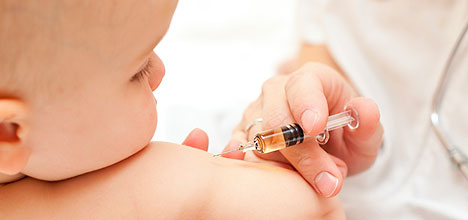
An immunisation providers event in Te Puke today marked day five of the Government's new immunisation health target – by the end of 2014, 95 per cent of all eight-month-olds will be fully vaccinated.
Health Minister Tony Ryall delivered a speech in Te Puke explaining how the immunisation target replaces 'the highly successful” target focused on lifting the immunisation rate of two-year-olds.
'In the past three years of the earlier health target, New Zealand went from one of the lowest immunisation rates in the developed world to one of the best.
'Today I can tell you that 93 per cent of all kiwi two-year-olds are fully immunised. That compares to only 67 per cent in 2007.”
Tony says there is virtually no difference in the rates between ethnicities or family income.
'This is one of the most significant public health achievements of the past 10 years.
'When new parents ask about immunisations now, health professionals can proudly say that even though immunisation is voluntary in New Zealand, 19 out of 20 parents are trusting vaccination.”
He says immunisation is one of the most effective public health interventions to prevent against infectious disease.
According to statistics, children are most vulnerable to infectious disease between three and eighteen months of age.
'We know if children begin their childhood immunisations on time, then that significantly increases the likelihood of completing all their vaccinations.
'That's why we've moved to the new health target: to focus on earlier, on-time vaccinations.”
An infant will be considered fully immunised if they have completed the schedule of three primary series of vaccinations by the age of eight months.
These three vaccinations are due at six weeks, three months and five months.
The three vaccinations cover diptheria, tetanus, hepatitis B, polio, haemophilus influenza, pneumococcal and whooping cough.
'Infants are at their most vulnerable to infections from about three to eighteen months of life because maternal immunity – which has been passively transferred to the infant across the placenta prior to birth – wanes over the first nine months.
'Acquired immunity from vaccinations takes several months to build up.”
Tony says newborns have little maternal antibody protection and are not well protected against whooping cough until the third dose of vaccine at five months.
'There is no antibiotic treatment for whooping cough. Between one and three out of 1000 infants who contract whooping cough will develop permanent neurological damage and five in 10,000 will dies.”
The current whooping cough outbreak began in August 2011.
Latest available data indicates a total of almost 2,900 cases have been notified. Of these notifications 194 were infants under one year old.
'That's seven per cent of all cases, and 94 of these babies were hospitalised. That's 61 per cent of all hospitalisations.
'A key part of achieving the new health target is at-birth enrolment in a general practice, and Well Child provider.”
Tony says right now, most babies are registered with a general practice when the mother or father first goes to visit the GP after the baby's birth.
'In many instances this is after six weeks, when the first vaccination is due at six weeks.
'Some information suggests that fewer than half newborns are not enrolled at 12 weeks of age – most finally getting enrolled around 13 to 14 weeks.”
Tony says from this week, maternity unit staff will be able to notify general practices of a child's birth before mother and baby leave the unit.
'The practice will then be able to enrol that baby into their patient management system.
'It makes it easier to help the parents get on-time immunisation of their child, because it's easier for the general practice to remind the parents.”
Maternity staff will also notify the parents' preferred WellChild provider of the baby's birth too.
'Boosting infant vaccinations requires a total effort by all the health professionals working with parents and newborns: midwives, general practice, hospital staff.”

0 comments
Leave a Comment
You must be logged in to make a comment.