


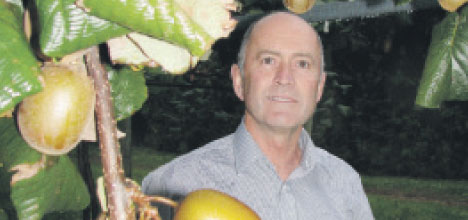
The New Zealand kiwifruit industry needs more `teeth' to protect it from further spread of Psa-V and future pest and disease threats, believes Barry O'Neil, newly appointed chief executive for Kiwifruit Vine Health.
Legal powers similar to those for the control of TB in livestock could assist the industry to take action over Psa-V and any other serious diseases or pests, says Barry, who has an extensive background in bio-security.
Barry O'Neil, new chief executive for Kiwifruit Vine Health.
There is concern among growers that poorly managed and abandoned orchards that may be infected with Psa-V (Pseudomonas syringae pv actinidiae) could cause further spread of the disease, which has severely impacted Hort16A gold kiwifruit vines in the Te Puke area in particular.
'Many growers think the industry needs more teeth and legal powers to take action over such orchards or the movement of risk equipment and plant material, especially into areas currently free of Psa-V.”
Barry also says reporting of the disease should be mandatory, even though there may be a perceived stigma attached to admitting growers have Psa-V in their vines.
'The last 15 months since Psa-V was first identified in New Zealand have been a roller coaster ride for the industry as the disease spread rapidly. I congratulate KVH staff and John Burke (former general manager of KVH), Kiwifruit Growers Inc, Zespri and the wider industry for their response to the disease and the measures they put in place to support affected growers and plan a pathway forward.”
That pathway includes the grafting this winter of new varieties that have proved to be more tolerant of the disease but Barry says finding a cure for Psa-V is unlikely and growers must now learn to live with it.
Te Puke has been hardest hit but the disease has also appeared in South Auckland, Katikati, Whakatane, Opotiki and Tauranga and while infection levels are currently low, it is vital they remain that way.
Keeping Psa-V out of the currently uninfected areas of Kerikeri, Hawke's Bay, Gisborne, Nelson and the Waikato is also essential, which is why KVH will increase its focus on bio-security.
Barry says everyone involved in the industry must play their part to reduce the risks of spreading Psa-V and he commends the postharvest companies in particular for the initiatives they have taken to put in place codes of practice and to invest in equipment to clean bins and vehicles.
Even in a Psa-V environment, Barry has every confidence the New Zealand kiwifruit industry has a bright, sustainable future and the integrated nature of the industry is among the reasons for his optimism.
It is also the reason he was happy to take up the new three-year appointment as chief executive with KVH, moving to the Bay of Plenty to live on the two canopy hectare orchard he and wife Hilda own at Ongare Point, just north of Katikati.
'Just before Psa-V was discovered in New Zealand we grafted some of our green kiwifruit vines to the new gold variety G3 and so far the fruit is looking great.”
It's not the first orchard the O'Neils have owned. They invested in the industry in 1984, even though Barry's professional background is in animal health rather than horticulture.
'I have always enjoyed the kiwifruit industry and the people involved in it. I'm looking forward to doing more of the work on our Ongare Point orchard now I am living in the Bay and renewing my contacts across the industry.”
Barry is no stranger to the Bay of Plenty. His family moved from the Manawautu when he was at primary school and he completed his secondary education at Te Puke High School before doing a veterinary science degree at Massey University in the 1970s.
His first position after graduating was with Barkes Corner Vets in Tauranga before he joined MAF as a veterinary officer, which included inspections in meat works and TB control. In 1994 he became the chief veterinary officer for New Zealand.
Barry has significant biosecurity knowledge from several years in senior management and leadership roles with MAF Biosecurity NZ, in New Zealand and overseas, including four years in Brussels with New Zealand Foreign Affairs and Trade. His experience includes international standard setting and trade negotiations; biosecurity risk-management activities involving the border, surveillance, response and eradication; and organisational change management. Barry led MAF's emergency response efforts into a number of incursions, including the Rabbit Calicivirus Disease in 1997, the Waiheke Island foot and mouth disease hoax in 2005 and, more recently, the initial MAF response efforts to Psa.
When Barry left MAF he established his own consultancy business, which took him to Abu Dhabi and Europe. He is also past president of the European-based World Organisation for Animal Health, having held the presidential role from 2006 to 2009.
'The organisation has 178 member countries from very poor developing nations to the most affluent. It works to develop policy to keep animals free from diseases so member nations can trade safely. It is one of three sister World Trade Organisation agencies. The other two are concerned with plant health and food safety.”
Hilda and Barry have four children: Andrea, 28; Kerry, 26; Eamon, 24; and 16-year-old Liam. 'Liam and Hilda will move from Wellington to the Bay of Plenty at the end of the school year. We are all looking forward to making our home here, as Hilda also grew up in Tauranga and has family here.”
Barry says the Bay's weather is another attraction.

0 comments
Leave a Comment
You must be logged in to make a comment.