


Steven Basi grew up on his parents' farm in the Waikato. Following in his father's footsteps Steven has been farming in the Waikato since he left school in the 1980s.
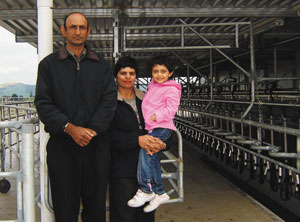
| Steven and Karen Basi with youngest Rachel. |
In 1995 Steven and wife Karen moved from Rukuhia to Eureka, where they bought and improved a dairy farm.
In 2004, with his father's farm at Puketaha having been sold in the previous year, they also invested in a very run-down 115 ha farm on Kereone Road, near Morrinsville, with a 50:50 sharemilker running a Jersey herd.
In 2007 the sharemilking contract was taken up by longtime friends, Len and Becky Walling, who purchased 400 Friesians and employed a contract milker, Stephen Briant.
For the 2008/09 season the worn out 30 a-side herringbone shed has been obliterated. A new 36 a-side was, at the time of my visit, being used by one cow and waiting for the other 399 to calve.
Stephen commented gratefully on the support and assistance he had received from Paul Aveyard of the National Bank through the whole process of bringing the farm up to standard with new fences, races and now the new shed.
When building a new farm dairy, farmers tend to hold to the adage that you go back to contractors who have served you well in the past. So construction of the shed and yards were handed to Don Chapman who had previously built them a new shed on the Eureka Farm.
Don has used a tried and true design of polypanel walls and a mono-pitched long span roof, the design of which discourages nest building by local birds.
On first look it seems a fairly basic and utilitarian shed, but both shed and yards have been designed to be easy to work in with not too much to go wrong.
Construction began in November and, apart from small details, the shed was finished by the end of April.
The circular yard has a water driven double backing gate, and the gate drive has a solenoid control operated from the pit by a pull cord.
The pull cord allows solenoid control from any part of the pit.
The yard design allows for free flowing entry to the bails, making for good cow flow.
The yards also contain drafting yards either side of the exit area plus both an AB race and a nine metre long vet race with a fold down rail along one side and a head bail at the end.
There is also a loading race facing the tanker area.
The cow platform is wide and the plant is installed at 700mm centres.
In the pit area there are extra drop down gates at the entry points to stop too many cows entering at once.
A feature appreciated by those milking in the shed is a step rail along the side walls of the pit.
This makes times when the milker needs to be taller to carry out some tasks, such as checking ear tag numbers, a manageable step, rather than having to climb right out.
Water for this property comes from a bore, and Aqua Tanks have installed two of their large green tanks to ensure that there is enough storage.
All races on the farm, and most of the fencing, have been replaced and the land around the shed has been recontoured to provide a large flat area for the shed and yards as well as a gravelled open area that will serve as a turnaround
for tankers.
There are four houses on the property. Two are now rented and the other two used as staff housing.
The original power lines in to the shed and houses were in a dreadful and dangerous state, and Terry Boubee of Laser Electrical in Morrinsville explained that they had had to install both new poles and a new transformer before starting work on the shed electrics.
Even in relatively simple sheds these days the electrics to operate the plant and pumps are very sophisticated, with vertical rows of connections concealed within metal cupboards.
Laser Electrical are very conscious of their ability to provide a high class job which works from day one. Evidence of this could be seen in the wiring of lights and power switches, which are all waterproof and clustered for easy use. They also installed the sludge and water pumps and the wash down control system which can either be operated from a switch in the pump room, or by a red cord running along above the pit.
In line with his policy of sticking to the tried and true, Steven had chosen a Waikato Milking Systems plant and Te Awamutu Milking Machines (TMC) for installation. He had used both before at Eureka and been happy with the system and the service.
Even fairly basic milking systems today have elements and systems incorporated which could only be dreamt of a few years ago.
The Waikato Supa 4 system includes a 100mm milk line plus electronic NT24i independent 2x2 pulsation. Each pulsator controls two clusters. The clusters have Waikato 320 claws with auto shut-off and the plant is powered by a BP200 blower vacuum pump with a Waikato Smart-
Air variable speed controller. The jetters are mounted on swing-down arms and lowered to a more appropriate height for use during the wash mode. These days TMC have a policy of offering clients a complete range of services, and had also been responsible for design and installation of all the water systems, the refrigeration and the effluent disposal systems.
Steven has played safe with his new effluent system, which has a 30,000 litre tank set part way down a bank near the entry point to the yards, but which is also connected to the largest of the old effluent ponds.
This gives him adequate storage, if needed, until the weather is suitable for using the travelling irrigator. Piping for this covers 30ha, and the system will be expanded in future years.
Overall this farm dairy contains most of the ideas and equipment considered as necessary in sheds these days, but has been carefully designed so that there is not too much to go wrong for the staff required to use it.

0 comments
Leave a Comment
You must be logged in to make a comment.