


One of the country's top kiwifruit growers says there is a lot to learn about growing the new Gold variety – G3.
It is being touted as a possible replacement for the lucrative Gold variety, Hort16A, as this variety is proving vulnerable to the bacterial vine disease Psa-V.
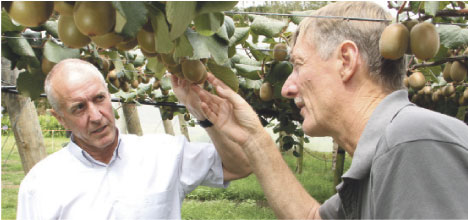
Orchard manager Colin Jenkins , right, with KVH general manger John Burke inspect the Gold3 fruit. Colin says growers have to learn how to grow the new G3 Gold variety.
Colin Jenkins manages the Maori trust Ngai Tukairangi at Matapihi in the Bay of Plenty.
The trust has more than 50 hectares of kiwifruit, including 24ha of Green, 18ha of Hort16A and 10ha of new varieties.
He was one of the trial growers for G3 three years ago and then tendered and got more G3, G14 and G9 in 2010 when the licences became available for the new varieties.
The trust now has 4ha of G3 producing and a further 2ha, which were grafted last year.
'It's no problem to get big fruit (with G3),” says Colin.
'But G3 does grow differently; we have to learn how to grow it.
'It's less vigorous than Hort 16A and it appears you need more winter chilling than the Gold we've been growing because we struggled with bud break this year.
'We were disappointed in our bud break this year; there are probably about 3000 trays/ha – we had hopes for more.”
Colin says there was a poor bud break across all the crops after a mild winter.
G3 doesn't break bud so easily off the leader – so there are more challenges in getting replacement cane for the following season.
'I think we put the Hi-cane on too early; maybe the copper (Psa-V protectant spray) has upset it as well.”
They got 15,000 trays per hectare last season off the G3 trial area though, which was a good crop, says Colin.
He says it was a struggle to get good dry matter.
Kiwifruit is graded into three dry matter categories: Y, T and M (Y is the highest dry matter quality).
'But all dry matter was down last year. We got into the T band – which is a reasonable dry matter result.”
Colin has 13ha of Hort16A left after cutting out 3.5ha in August.
He cut the vines back to the stump three weeks after they showed symptoms of Psa-V.
'We made the decision to cut them out early – 1500 vines. We didn't want to risk it.”
He is constantly monitoring the remaining vines in the orchard.
'We cut five canes out of the Hort16A last week.
'We are monitoring the orchards very closely – weekly during the wetter periods we've had.”
Colin, who has been growing kiwifruit for the trust for more than 25 years, says they can't really complain about a bad harvest this year.
'We were all Green, then in ‘96 we grafted to Hort16A – we were one of the larger Gold growers for a number of years.”
Forty per cent of the orchard areas went to Hort16A, and Colin says a couple of years ago they were thinking about why they hadn't grafted over everything when the money was so good. 'But now, we've got Green, which is showing to be more tolerant to Psa-V, and some new varieties which appear more resistant.
'I think that we're lucky because we're so diversified.
'It hasn't been a good year for us because we didn't have a good bud break on any of our varieties.
'We're a bit disappointed – and we've been dealing with Psa issues at the same time and loss of crops, but we've had some very good years, so we can't complain really.”
Colin says no other growers in the Matapihi area have Psa-V infections.
'We have a very proactive Matapihi growers group to look at Psa-V issues.”
Kiwifruit Vine Health general manager John Burke says the aggressive decision to cut back vines early is paying dividends for Colin.
'Psa-V is certainly not rampant (through his orchard).”
Because Colin cut out the vines so early, the regrowth from stumps is significant – with four suckers growing up from the vines, which Colin has secured.
'This is a good model, this is what we're exploring for re-grafting,” says John, 'having four suckers coming up from the root, strung up”.
He says other Hort16A growers who have tried to take their affected crops through to harvest have 'given up” and had to cut off the affected vines during summer.
'They will not have the same level of sucker growth to graft onto. They will instead have to graft onto the stump.”
Orchardists will usually graft onto a stump during winter and onto suckers in summer, but John says they would probably prefer to have suckers to graft onto.

0 comments
Leave a Comment
You must be logged in to make a comment.