


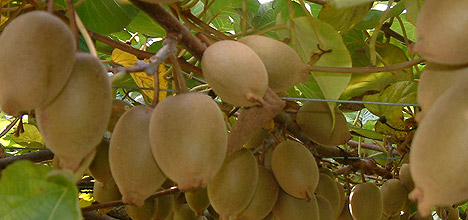
The Psa-V virus destroying Zespri's Hort16A Gold kiwifruit strain may provide Turners and Growers with the lever that opens New Zealand kiwifruit exports to non-Zespri varieties.
T&G is now declaring publicly something they have known for months – Psa-V is not affecting its EnzaGold variety.
Te Puke orchardist David Marshall is growing both Hort16A and EnzaGold on the same orchard. His Hort16A vines are withering, while a few metres away the EnzaGold remains Psa-V free.
The Marshall orchard is the first in New Zealand to show the impact of Psa-V on the two varieties growing side-by-side.
David Marshall is cautiously optimistic his EnzaGold crop could be a potentially viable Gold variety that can be farmed through Psa. This season, production from his EnzaGold crop is increasing in line with projections. The crop, in its second year, is on track to jump in production from 6000 to 14000 trays per hectare. David estimates he will lose at least half of his Hort16A crop to Psa.
Not free to export
'It's absolutely heart breaking to see all the hard work and investment in the ZespriGold going to waste, but on top of that, I have all this beautiful fruit right next door and it's doing so well, but growers cannot freely export it,” says David.
Under the Kiwifruit Export Regulations 1999, only Zespri is permitted to export kiwifruit from New Zealand to markets other than Australia. It has only two varieties; the green Hayward kiwifruit, which even before Psa was uneconomic for many growers with returns below the cost of production, and Hort16A ZespriGold, which has been a cash cow for the industry. But now, according to some industry figures could, and should, be completely cut out as soon as possible to lower the pressure from the airborne bacteria.
David Marshall says he planted Enza Gold alongside the Zespri's Hort16A because he thought it important to spread his risk across different varieties.
'I've always believed it's good to have something else to compare with.”
David says he grew the different varieties out of interest and he decided to put in the ENZAGold because there was nothing else at that time without a beak on the fruit.
David has been growing kiwifruit since 1975 and believes the industry should be run by a single desk.
'Single desk is still the best system – it's the only way. But you've got to work in with collaborative marketing. It takes all parties to make it work.”
Hort16A must go
'The fact of the matter is the Hort16A vines must go,” says Lee Hoggard, another Te Puke based EnzaGold grower.
'The sooner we cut out every vine in the country and start again the better. While our other varieties are showing pretty good resistance to Psa at this stage, every time it rains the air becomes a toxic soup of Psa inoculum. So we continually have to spend more on sprays and disease management to keep our orchards safe.
'When it comes to allowing other potentially viable gold varieties for export, Zespri and the government have got blinkers on,” says Lee.
'I'm worried they'd sooner let the whole industry go down than let people sell other varieties overseas. Surely they must realise it's not about the monopoly debate anymore, it's about the survival of growers and the industry.”
David Marshall says he planted Enza Gold alongside the Zespri's Hort16A because he thought it important to spread his risk across different varieties.
Chris Dunn, another Te Puke orchardist says it is dangerous having the entire crop coming from a narrow group of genetics from Zespri's breeding programme, especially as no one can guarantee a variety to be 100 per cent resistant to Psa or any other future unknown diseases.
'With horticulture you need biodiversity to ensure a safe future,” says Chris.
'If we get into the same situation where we have a monoculture again, a year down the track we could find ourselves in the same boat. The ZespriGold crop in Italy was decimated by Psa, but across their national crop they had several different varieties, so they're coming through it.
'Our industry as a whole needs to spread the risk and invest in several viable varieties and orchardists themselves should also be growing at least two or three varieties for the same reason.”
The way forward
Turners & Growers managing director Jeff Wesley says allowing kiwifruit growers to graft over to a range of different varieties, which are showing potential to be farmed through in a Psa environment, is the only way forward.
'One look at David Marshall's orchard will show you why,” says Jeff.
'Decisions this winter will be critical to the survival of many kiwifruit orchardists. If they can't graft over to new gold varieties this year, they may not survive. We have plenty of vine stock, which in most cases can be grafted directly onto the grower's existing rootstock and be producing within two years.”
The international fresh produce trade is all about relationships says Jeff.
'When there's a void, someone will fill it. If New Zealand gold kiwifruit is off the shelves for too long another country will fill that space and we'll be left on the side line. Every year that passes – and we are talking in years, it'll be harder for New Zealand kiwifruit to get back in.”

0 comments
Leave a Comment
You must be logged in to make a comment.