


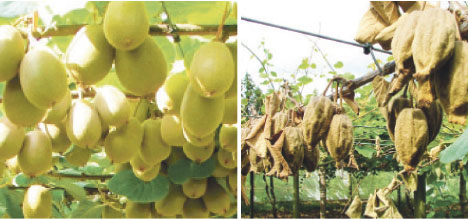
On the same day Zespri announced it will look to tender more licences for the new Gold3 variety in May – which is proving to be more resistant to Psa-v than Gold HORT16A – Turners & Growers announced its ENZAGold variety is resistant to Psa-V.
Meanwhile, the independent organisation set up in response to the Psa outbreak, Kiwifruit Vine Health Inc, is unable to test the two varieties against each other as T&G is suspicious of KVH's ‘independence'.
KVH is a pan-industry group, established following agreement of the Industry Advisory Council to transition the management of the Psa response from MAF Biosecurity NZ and Zespri to a separate entity.
KVH is working with T&G on ways to compare the relative Psa-V tolerance of different cultivars.
'One of the difficulties we are having is trying to get some quantitative field observational data on the various cultivars,” says KVH general manager John Burke.
'It's all very well saying my variety is tolerant, but what's the relativity of that?”
KVH is trying to line up all the cultivars so an objective tolerance of the various cultivars can be made, but there is suspicion about KVH's place in the scheme of things.
'I guess from their (T&G) point of view, they might be cautious about the independence of that assessment,” says John.
'We will try and get a process underway where we can.
'We have got to try and overcome some issues there and perhaps work out a process whereby they are comfortable that it is being handled in a proper arms-length fashion.
'But it is important to growers and it's important for KVH that we are able to measure that properly. So that's what we are trying to overcome at this stage.
'You can't say you have got a tolerant cultivar unless it's lined up.
'You have got to actually put your money where your mouth is, basically.”
Unable to advise growers
VH would not be able to advise growers on the relative merits without being able to back it up with a good comparative process.
'We are trying to get everyone to line up and have a process whereby we can get an objective assessment of the relative tolerance of each cultivar. And we haven't quite got there yet.
'We are measuring G3, G9, G14 – Zespri cultivars, but just getting the permission of the owners to get in and look at the other ones and do some robust assessment is proving a little bit difficult just at the moment.”
Psa-V tolerance is only part of the puzzle, says John. There are cultivars that have a known tolerance to Psa-V, but commercial attributes have also got to be considered like storage ability, and even if people like the taste.
'You have to tick the boxes on those, it's not that easy,” says John.
'Everyone's got to front up and be measured.”
Zespri announced in February they would release more licences for Gold3 in May if it continues to show resistance to Psa-V.
G3 10 years in making
Zespri innovation manager Bryan Parkes says Gold3 has spent 10 years going through various testing and trials in the export market.
Bryan says Zespri has spent in the hundreds of thousands of dollars per year on the exploratory stages of testing G3 and then into the millions when testing against consumers and markets.
'We're spending, on new cultivars, $5-6million a year,” says Bryan.
Bryan says a company could market an untested variety of kiwifruit on the market, but there would be a high chance of failure.
'A lot of cultivars fail.
'If you're a company that just wants to get a cultivar out there you can just launch a whole heap of cultivars and if it falls over it's the growers' fault.
'It didn't cost you much to release it because you didn't invest much and if it fails it's not your problem.
'We are at the other end of the spectrum; when we release cultivars and it fails, we're in there with the grower, sharing the pain. So we put in the appropriate amount of work.”
Bryan says he has yet to see any data from T&G on its ENZAGold performance.
'I believe they've started selling it, but I haven't seen any data on how it's performing.”
Zespri is considering two options for releasing G3 licences: The first option is a simple commercial proposal, offering an opportunity to all. Under this option, Hort16A growers will be paid $5000 per hectare to return their existing Hort16A licence. The grower can then choose to join a commercial (closed) tender process, whereby the highest bids are successful.
Two options for licences
The second option is intended to provide opportunity for all Hort16A growers to access a licence if/when they deem the timing to be right to re-graft based on their personal circumstances. Under this option, Hort16A growers can make a fixed price bid (proposed to be $12,000 a hectare) for enough Gold3 licence to replace their existing Hort16A plantings.
Under both options, a further 400 hectares of Gold3 are being released to give non-Hort16A orchards an opportunity to buy Gold3 licences and diversify their growing portfolio.
Also, under both options there will be the opportunity to make a deferred payment, with deferred payment terms being offered on 80 per cent of the cost. Growers can re-pay the money when their orchards begin to produce again.
A further 200ha of Green14, a sweet Green variety, which is also showing a positive market response and a good level of tolerance to Psa, will also be made available.
Zespri says G3 has naturally high orchard yields, appears easier to manage through the supply chain than Hort16A, stores well late in the season and delivers a good eating experience to consumers, with positive responses received through in-market consumer sensory work over consecutive seasons.
Zespri is discussing the options with growers and other industry representatives to seek their feedback on any licence release process during March, before the Zespri board makes a final decision on the release in March 2012.

0 comments
Leave a Comment
You must be logged in to make a comment.