


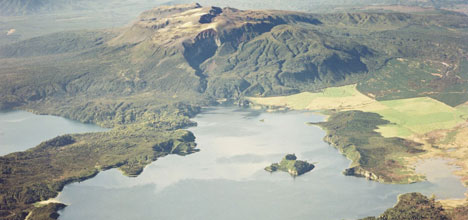
The scientists who found remnants of the Pink and White Terraces under Lake Rotomahana are going back to unearth more information about the geothermal system that created them.
In a 10-day project starting this month, the scientists will build on the information they gathered last year by first remapping the lakebed at a higher resolution than the map they compiled last year.
Lake Rotomahana.
They will then use seismic equipment to get a clearer picture of the geological structures under the lake floor to a depth of about 70m.
The seismic equipment, which will be towed behind a boat, releases acoustic vibrations that will penetrate the lake floor and bounce off geological layers and be recorded on special underwater microphones attached to the boat.
This will enable the scientists to see through the thick layers of mud and sediment and image fault lines and rift zones that define the 1886 eruption of Mount Tarawera and potentially, the upflow channels of the lake's geothermal systems. They will use the data to make charts showing cross sections through the upper parts of the Earth's surface below the lake floor.
Project leader Cornel de Ronde, of GNS Science, says as well as finding out more about the lake's extensive geothermal systems, he hopes to get clearer images of the remnants of the Pink and White Terraces.
'Lake Rotomahana is no pushover and it has been slow to yield its secrets,” says Cornel.
'After being shrouded in mystery for over 100 years, modern technology is slowly peeling back the layers of what is a unique natural environment.
'I'm reasonably confident the seismic survey will provide more evidence that parts of the Pink Terraces survived the Tarawera eruption.
'However, I'm less confident about the White Terraces as the area where they were located appears to have been more severely affected by the Tarawera eruption.”
Until last year's investigation, it was thought that the terraces were destroyed in the 1886 eruption and permanently lost.
The lake is roughly 3km by 6km and about 120m deep at its deepest point.
It enlarged to five times its original size after the Tarawera eruption.
During last year's project, the scientists found dozens of vents on the lake floor where hot water and gas enter the lake. This confirms there are active geothermal systems under the lake.
The scientists are keen to learn how the geothermal systems survived being at ground zero during the Tarawera eruption, and how they have adapted at the bottom of a lake.
There are very few examples of ‘drowned' geothermal systems in the world.
At the same time, the seismic images will hopefully provide clearer images of the Terrace remnants that were discovered last year by free-swimming robotic vehicles equipped with side-scan sonar.
Sonar signals are able to penetrate only a few centimetres into the thick mud on the lake floor.
Prior to 1886, the Pink and White Terraces were considered an international marvel and were sometimes referred to as the eighth natural wonder of the world.
'The project team is very excited about returning to Rotomahana because we have the opportunity of bringing the Terraces back to life for New Zealanders.”
Stage two of the project is being led by GNS Science, with assistance from the University of Waikato and the Te Arawa Lakes Trust Board in Rotorua.

1 comment
known
Posted on 01-03-2012 13:26 | By Capt_Kaveman
decades ago that if they drained the lake some of the terraces would become visable its a matter if iwi want it to happen
Leave a Comment
You must be logged in to make a comment.