


Do you enjoy walking through native bush and listening to the calls of New Zealand native birds?
Do you want to eradicate possums, rats, ferrets and stoats that endanger native plants and species?
‘Yes' – then Puketoki Reserve has a great volunteer role for you.
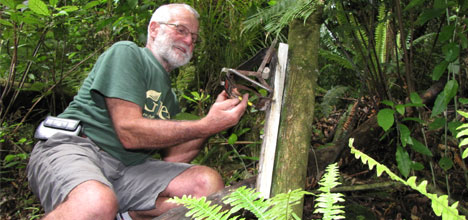
Colin Hewens sets a trap in the Puketoki Reserve.
The Puketoki Reserve in the hills of Whakamarama, between Tauranga and Katikati, is 40 hectares of flourishing native bush.
A group called ‘Friends of Puketoki' attend trap lines regularly, eradicating possums, rats and ferrets.
Two volunteers are moving away from the area and the group is in need of two keen people to take over the maintenance of their trap lines.
The work involves about an hour and a half every two weeks, baiting and setting the traps, with two months off during winter.
The group is willing to train anyone interested in filling this role.
Friends of Puketoki was started with the help of group ‘Wild about New Zealand' and is funded by the Western Bay of Plenty District Council and the Bay of Plenty Regional Council. The councils supply traps and bait.
In the six years since the Friends of Puketoki programme was set up, a total of 392 possums have been killed – 56 in the first month.
Since then, 16 has been the maximum in any one month and now the average is down to about four possums caught a month.
The rat population has also dropped, says a Friend of Puketoki, retired school teacher Colin Hewens.
'We have fed about 10,600 Ditrac rat baits, sufficient to kill more than 350 fully grown rats.
'We seldom ever see dead rats in here though (now),” says Colin.
With Wild about New Zealand, the volunteers put down black tracker tunnels, which use a pre-inked tracking card to survey populations of small animals.
Lures are placed on the inked centre of the card inside the tunnel. While an animal eats the lure it stands on the inked section and the ink is transferred to its feet.
The rat then leaves evidence of its presence through ink paw prints.
Colin says rat paw prints are down from being on 100 per cent of the tracker pads, to five per cent, while wetas went up from five per cent to 60 per cent in the first two years.
'The wetas have just gotten bigger because the rats aren't eating them.”
The bird population has flourished along with the wetas.
When the traps were put in six years ago there was only one pair of North Island Robins.
'Listening to the bush back then, it was dead, silent,” says Colin.
At a count last November, there were 11 North Island Robins.
The bird numbers are estimated in a five minute bird survey, undertaken four times during the year.
'We listen for five minutes at five different spots around the reserve and count the bird calls.
'The riroriro, rainbird, is the most common bird.
'We have quite a few tuis, there are bellbirds, kingfishers and we get some kakas coming over from Tuhua (Mayor) Island in the winter looking for food.”
Anyone interested in becoming a Friend of Puketoki phone Colin (07) 552 6771 or Terry (07) 552 6222.

1 comment
Top Effort
Posted on 12-12-2011 15:39 | By justice
Well done to all of the VOLUNTEERS here. Thank you for your time and efforts to make this a better place for all.
Leave a Comment
You must be logged in to make a comment.