


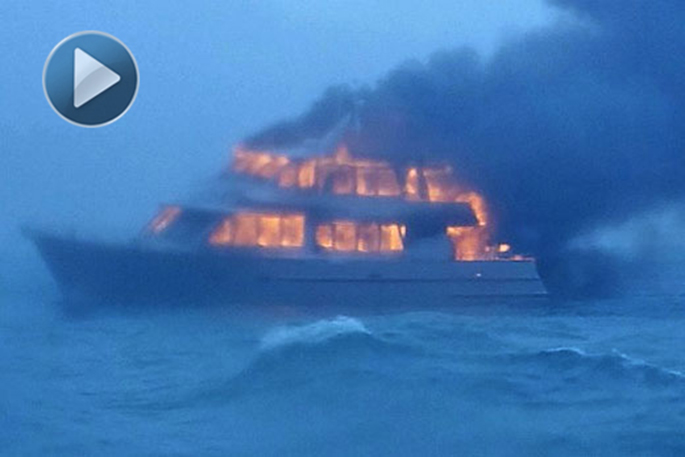
A report into the sinking of the passenger vessel PeeJay V, which caught fire at sea on January 18 2016, has found there was no fire alarm system on board.
According to the report released by the Transport Accident Investigation Commission, crew were also unable to access all of the life-jackets on board because of the fire.
For the same reason they were not able to launch the flotation raft that was stored on top of the vessel's flybridge.
The PeeJay V was near the end of a journey to White Island with 53 passengers and seven crew, and was approaching the Whakatane Harbour entrance when fire broke out in the engine room.
The crew released the fixed CO2 fire extinguisher into the engine room, which suppressed the fire for a short time.
The fire quickly escalated, forcing the skipper to order everyone to abandon the vessel.
Several vessels in the vicinity responded to the skipper's distress call.
All people were eventually transferred to the assisting vessels. However, due to the speed with which the fire gained intensity several passengers were forced to enter the water without a life-jacket, the report found.
The PeeJay V burnt to the waterline and sank. One crew member suffered from smoke inhalation, but otherwise nobody else was seriously injured.
Chief Investigator of Accidents Captain Tim Burfoot says the commission identified three key safety issues.
'First, maritime rules didn't require the PeeJay V to have a fire alarm. Second, the CO2 firefighting system failed because the engine room wasn't airtight. And third, the boat builder and its operator didn't fully appreciate how the CO2 system worked.
'For CO2 firefighting systems to be any use, the space has to be airtight and everyone involved should be fully trained and know how the system works.
'So, Maritime New Zealand has agreed to review its rules about fire alarms and remote extinguishers in vessels of this type with enclosed engine spaces.
'They have also agreed to encourage people who design, install and use CO2 fixed fire-fighting systems to fully document and understand how these systems work.”
The Transport Accident Investigation Commission determines the circumstances and causes of transport accidents and incidents with a view to avoiding similar occurrences in the future, rather than to ascribe blame.

0 comments
Leave a Comment
You must be logged in to make a comment.